


Views: 0 Author: Felix Publish Time: 2026-02-26 Origin: Site

Large-scale infrastructure expansion across North America, the Middle East, and Southeast Asia is fundamentally reshaping demand for double-wall corrugated (DWC) pipe systems.
In North America, the Infrastructure Investment and Jobs Act allocates over USD 1 trillion toward long-term modernization of transportation, water, and municipal systems. Across the Middle East, sustained multi-billion-dollar investment continues to flow into desalination networks, drainage infrastructure, and industrial urban expansion. Meanwhile, Southeast Asian economies are accelerating capital deployment in sewage, stormwater control, and irrigation upgrades as urban density intensifies.
Taken together, these capital commitments reflect long-horizon structural expansion rather than short-term stimulus cycles. As procurement specifications tighten under ISO classification, demand increasingly concentrates on SN4 and SN8 performance-grade DWC systems.
| Region | Investment Scale | Infrastructure Focus | Pipe Demand Characteristic |
| North America | > USD 1 trillion | Stormwater & rehabilitation | Replacement-driven stability demand |
| Middle East | Multi-billion USD | New urban networks | Expansion-driven growth |
| Southeast Asia | Accelerated capital programs | Drainage & irrigation | Urbanization-driven volume |
Infrastructure intensity is therefore converting directly into structural-grade pipe demand.
As infrastructure programs expand in scale, production volume requirements rise accordingly. However, throughput alone is no longer a sufficient benchmark of competitiveness.
Higher speeds compress melt stabilization time, narrow thermal equilibrium windows, and amplify geometric sensitivity. Under SN-classified procurement environments, manufacturers are required to increase output while maintaining strict mechanical compliance.
The industrial challenge is no longer speed, but stability at speed.
Ring stiffness is governed by structural mechanics rather than branding terminology.
S = (E × I) / D^3
Where:
S = Ring stiffness
E = Flexural modulus
I = Area moment of inertia
D = Mean diameter
Under ISO classification:
SN4 = 4 kN/m²
SN8 = 8 kN/m²
This relationship makes clear that stiffness depends fundamentally on modulus and geometry. Every processing variable—temperature, pressure, tooling precision—ultimately influences one of these two parameters.
For corrugated pipe profiles:
I ∝ h^3
Because inertia scales with the cube of rib height, small geometric deviations are mechanically amplified.
A 2% reduction in rib height may result in roughly 6% inertia loss. A 3% deviation can approach 9% stiffness variation.
Geometry instability is therefore amplified, not proportionally transmitted.
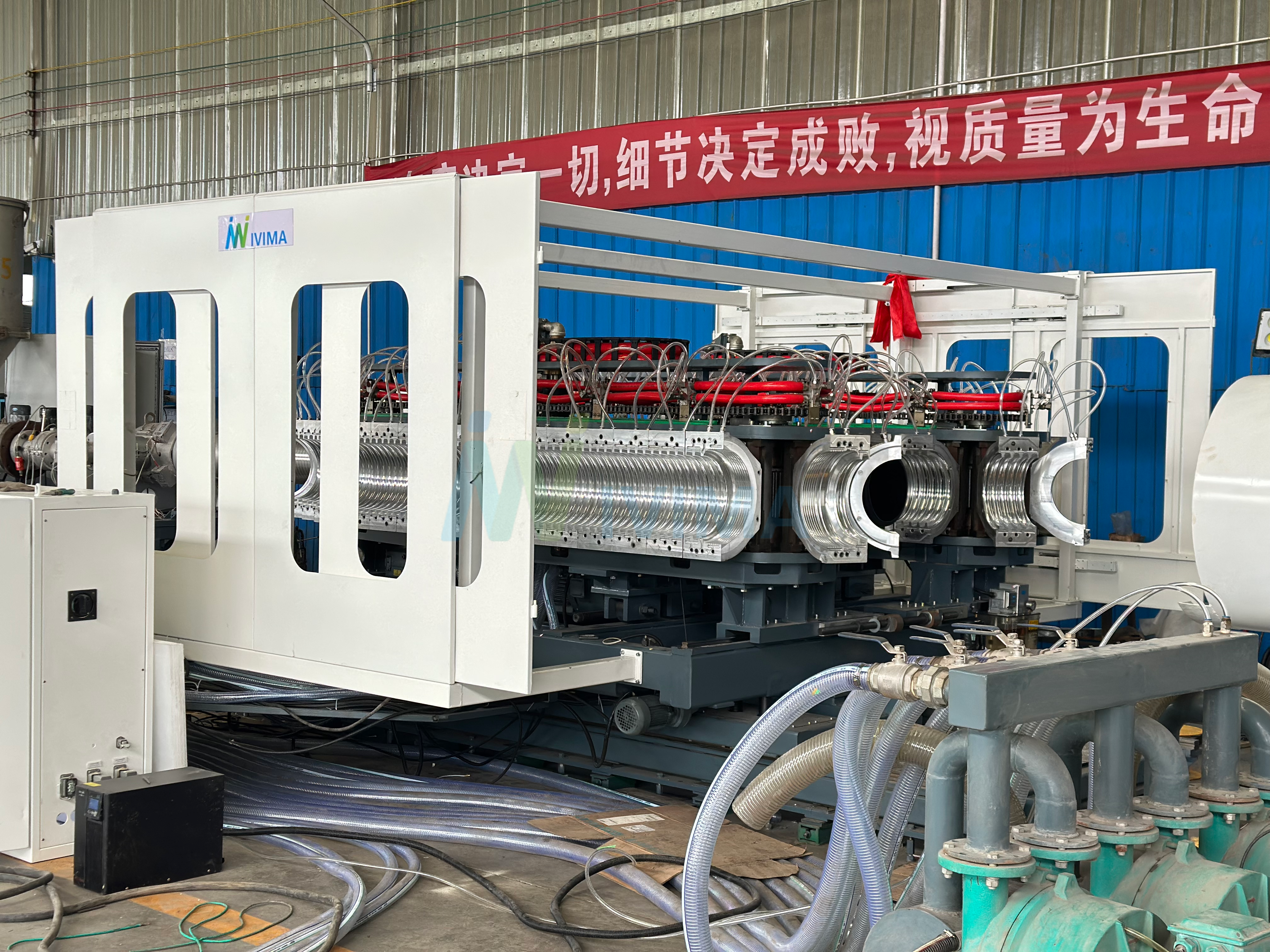
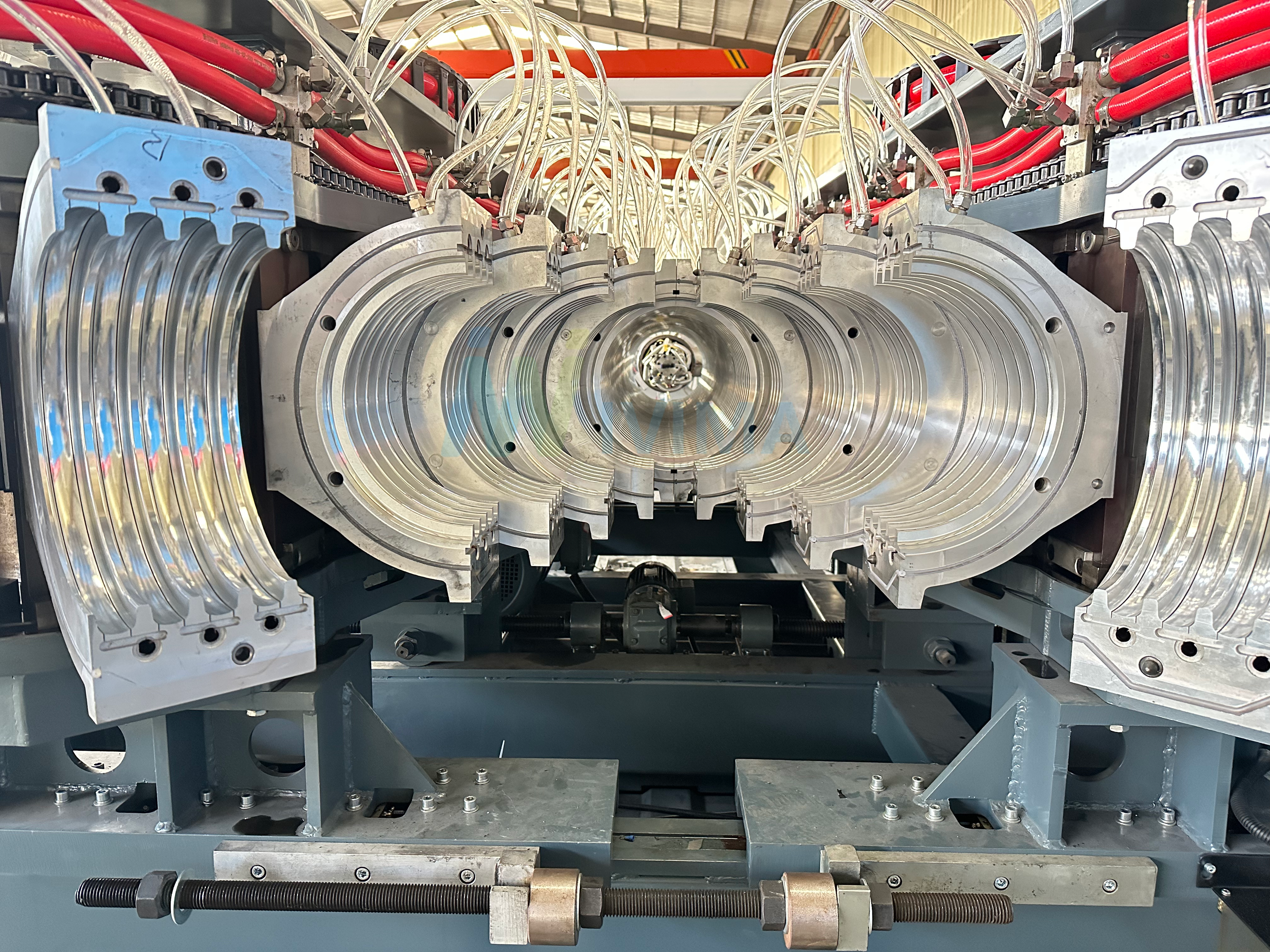
Within DWC production, rib geometry is defined by corrugation mold precision, vacuum distribution uniformity, and forming synchronization.
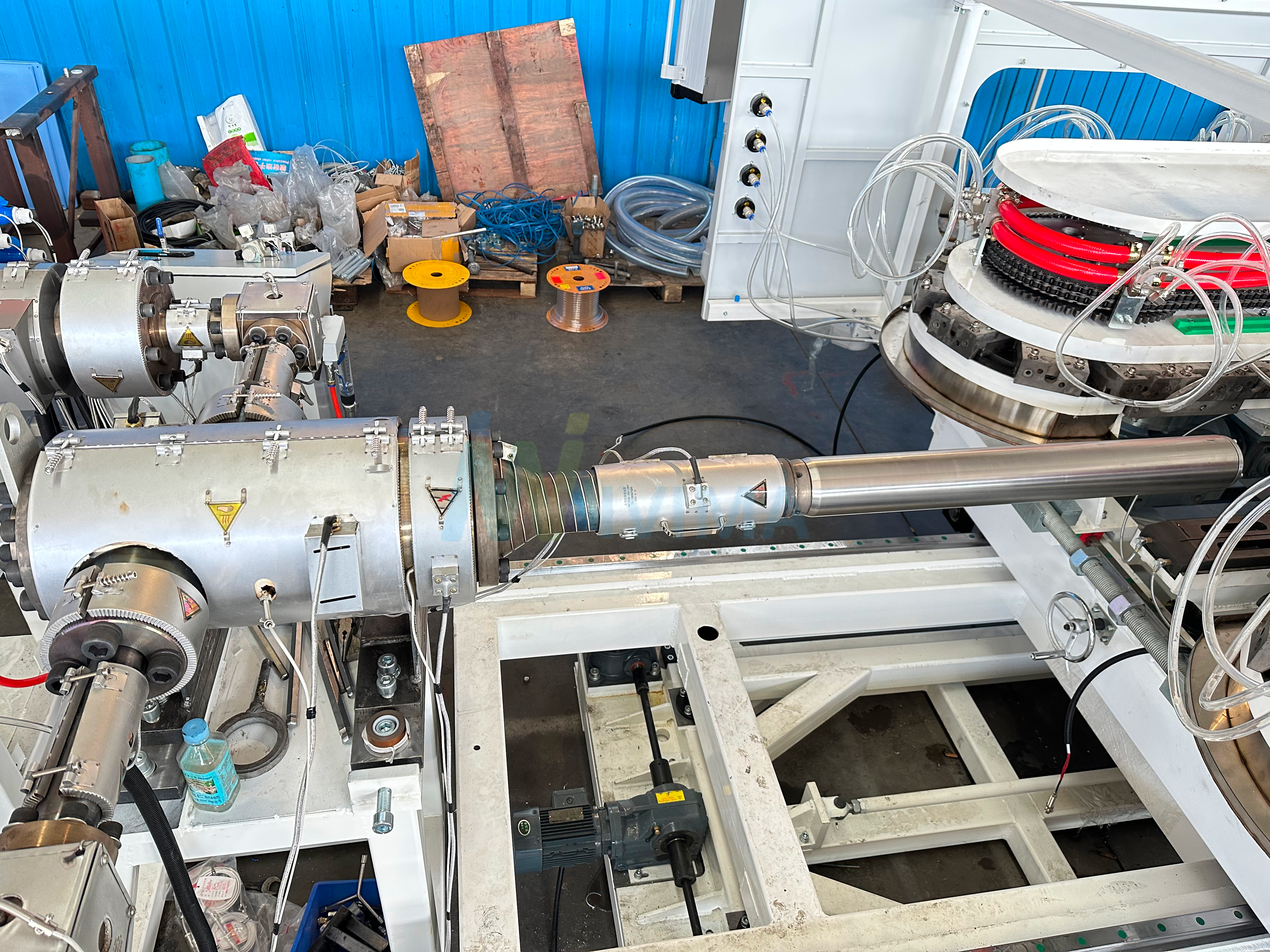
The modulus term (E) depends on molecular weight distribution, crystallinity level, and polymer chain entanglement density.
In semicrystalline polymers such as PP and HDPE:
Higher entanglement density improves creep resistance.
Improved creep resistance enhances long-term SN retention.
Because modulus is embedded directly in the stiffness equation, melt rheology control during extrusion becomes structurally decisive rather than merely procedural.
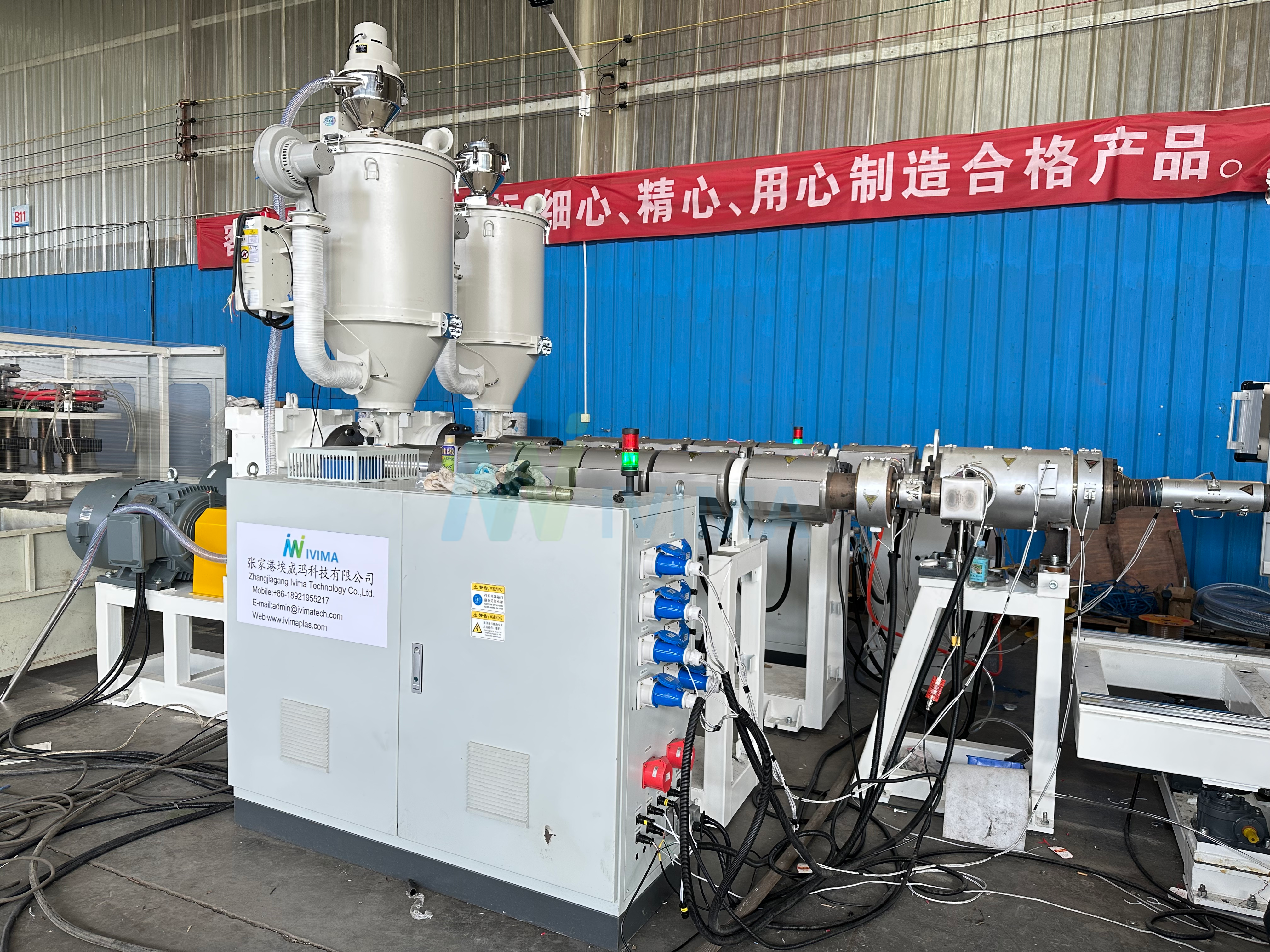
Material consistency directly defines achievable classification stability.
At elevated production speeds, melt residence time shortens and thermal stabilization periods contract. Pressure fluctuation effects become more pronounced, particularly during crystallization and forming.
Because stiffness scales cubically with geometry, forming precision becomes exponentially more critical under high-speed conditions.
| Structural Variable | Mathematical Relationship | Sensitivity Level |
| Modulus (E) | Linear | Moderate |
| Geometry (I) | Cubic | Extremely High |
| Diameter (D) | Inverse Cubic | High |
High-speed DWC manufacturing is therefore a process bandwidth control problem rather than a nominal output target.
When trillion-dollar infrastructure expansion converges with cubic geometric sensitivity, the defining constraint shifts from market demand to engineering control.
Maintaining SN4 and SN8 classification stability under elevated throughput requires synchronized management of:
Melt rheology stability
Corrugation tooling precision
Vacuum forming uniformity
Thermal and haul-off coordination
This integration is not optional; it is structurally embedded in the stiffness equation itself.
Industrial systems that coordinate extrusion stability, precision tooling, and forming synchronization demonstrate how structural mechanics is translated into production reliability.
In this context, integrated platforms such as IVIMA's high-speed PP/PE double-wall corrugated pipe extrusion system illustrate how process architecture can be aligned with structural physics requirements.
Under expanding infrastructure demand, classification stability becomes the true measure of high-speed manufacturing capability.


