


Views: 0 Author: Felix Publish Time: 2026-02-28 Origin: Site

The global corrugated pipe market has entered a sustained expansion phase, fundamentally redefining standards for municipal drainage, underground infrastructure, and utility protection systems.
By 2025, the global corrugated pipe market size is projected within the range of USD 15.57 billion to USD 22.0 billion, with a forecast compound annual growth rate of approximately 4.35%–4.5% through 2033. Market projections indicate total value may approach USD 32.24 billion by the end of the forecast period.
Within this expanding base, double-wall corrugated (DWC) pipe systems account for approximately 46.67% of total market share, positioning them as the structural backbone of modern drainage networks.
The Asia-Pacific region currently represents the largest production and consumption hub, contributing approximately 46.68% of global demand. This dominance is driven by accelerated urbanization, large-scale infrastructure upgrades, and expanded water management initiatives.
| Indicator | Value |
| 2025 Market Size | USD 15.57–22.0 Billion |
| CAGR (to 2033) | 4.35%–4.5% |
| 2033 Forecast | USD 32.24 Billion |
| DWC Market Share | 46.67% |
| Asia-Pacific Share | 46.68% |
Market growth is structural rather than cyclical, driven by long-term infrastructure capital allocation.
The acceleration of DWC production line investment is closely linked to material substitution trends.
Traditional concrete and cast-iron pipelines face persistent challenges, including chemical corrosion from hydrogen sulfide (H₂S) exposure, heavy installation costs due to excessive weight, and leakage risks at connection interfaces.
In contrast, HDPE and PP double-wall corrugated pipes offer:
High strength-to-weight ratio
Design service life of 50–100 years under appropriate installation conditions
Strong resistance to chemical and electrochemical corrosion
Significantly lower Manning’s roughness coefficient (~0.009 compared to ~0.013 for concrete)
Lower hydraulic roughness improves flow efficiency and reduces pumping energy requirements in long-distance drainage systems.
These performance advantages have made DWC systems the preferred solution for municipal stormwater, sewage, and highway drainage applications.
Manufacturing double-wall corrugated pipe involves a continuous thermoplastic extrusion and vacuum forming process.
A modern DWC production line typically includes:
Gravimetric feeding system
Dual extrusion units (or co-extrusion system)
Precision spiral-mandrel die head
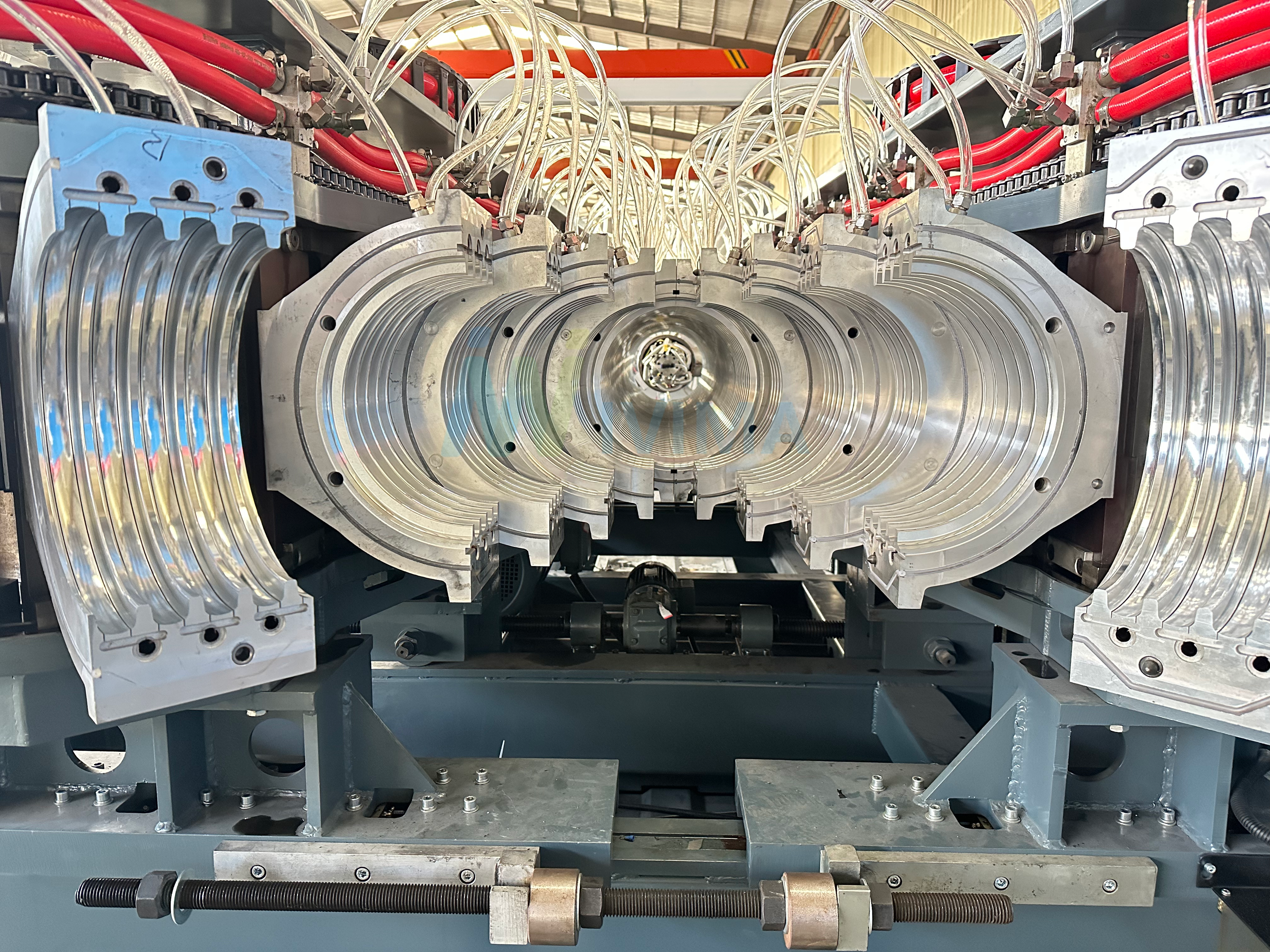
Corrugator with cooling and module transmission system
Vacuum calibration section
Chipless cutting unit
Automatic stacking system
Each subsystem directly influences structural performance, energy efficiency, and production stability.
The extrusion unit represents the thermal and rheological core of the production line.
For HDPE and PP processing, single screw extrusion remains the industry standard.
High-performance systems typically utilize:
L/D ratios between 33:1 and 40:1
Grooved feed sections
Optimized plasticizing zones
This configuration enables high throughput while maintaining controlled melt temperature, minimizing thermal degradation risk.
Optimized single screw systems can achieve specific energy consumption levels in the range of 0.08–0.12 kWh/kg, reflecting highly efficient plasticization.
When processing PVC, parallel or conical counter-rotating twin screw extruders are required.
PVC’s shear sensitivity and thermal instability necessitate forced positive displacement conveying rather than friction-based transport.
Twin screw systems allow:
Wider processing window
Higher filler loading
Improved venting and self-cleaning capability
Although initial investment is higher, formulation cost savings can significantly improve long-term return.
| Parameter | Typical Value |
| Single Screw Specific Energy | 0.08–0.12 kWh/kg |
| Overall Line Energy (Advanced Systems) | ~0.31 kWh/kg |
| Optimized Condition | ~0.15 kWh/kg |
| Resin Share of Production Cost | 70%–80% |
Material and energy efficiency directly determine long-term profitability.
Traditional spider dies may introduce weld lines that weaken pressure resistance and ring stiffness.
Modern DWC systems adopt spiral-mandrel die heads, which:
Eliminate weld line formation
Promote circumferential melt distribution
Improve wall thickness uniformity
Multi-layer co-extrusion technology further enhances cost structure optimization.
Three- or four-layer die configurations allow:
Thin outer/inner layers of virgin resin
Up to 70% recycled PCR material in the core layer
This layered structure preserves mechanical integrity while reducing material cost per meter.
The corrugator determines geometric accuracy, surface quality, and production speed ceiling.
For pipe diameters below approximately 500 mm OD, continuous chain track systems provide high linear speed through circulating module arrays.
For diameters of 800–1800 mm, continuous systems require extensive module arrays, increasing footprint and tooling cost.
Shuttle transmission systems reduce module requirements to approximately 6–10 pairs per side, even for large diameters. Modules disengage after cooling and return via a high-speed track to re-enter production.
This architecture significantly reduces heavy tooling investment and accelerates changeover efficiency.
I is proportional to h^3
Where h represents rib height.
Because structural inertia scales with the cube of rib height, small geometric deviations can generate disproportionately large stiffness variations.
Within DWC production, rib geometry is defined by corrugation mold precision, vacuum distribution uniformity, and forming synchronization.
Thermal management defines the physical limit of production speed.
Water-cooled systems utilize internal cooling channels within aluminum mold blocks, providing substantially higher heat removal capacity than air-based systems. Production speeds of up to 25 m/min for 250 mm pipes and output levels exceeding 750 kg/h can be achieved under optimized conditions.
Air-based supercooling systems eliminate water leakage risks and simplify maintenance but may limit maximum output in thick-wall large-diameter applications.
Each approach represents an engineering trade-off between performance ceiling and mechanical simplicity.
Advanced DWC lines integrate Siemens or B&R PLC control systems for synchronized coordination between:
Extruder screw speed
Haul-off velocity
Corrugator module speed
Gravimetric feeders and ultrasonic wall thickness scanners enable real-time weight control.
Without closed-loop control, operators often increase output to avoid under-thickness risk, causing 3%–5% material giveaway.
Automated systems can reduce excess material usage by 1%–2%.
Assuming:
1000 kg/h production
7000 operating hours annually
7000 tons resin per year
A 1%–2% material saving corresponds to 70–140 tons of HDPE annually.
This reduction can significantly shorten payback periods for high-end automation systems.
Initial capital expenditure varies significantly based on diameter range and system sophistication.
| Configuration | Estimated Budget |
| 200–800 mm Line | USD 70,000–150,000 |
| 1200–1800 mm High-Speed Co-Extrusion Line | USD 350,000–1,000,000+ |
| Typical Line Length | 40–60 meters |
| Large Corrugator Weight | > 43 tons |
Factory planning must consider heavy-load foundations, overhead cranes, and storage space for large-diameter finished pipes.
Under representative conditions:
1000 kg/h output
7000 hours annual operation
1%–2% material savings
High-performance systems can achieve payback within approximately 8.5–14 months, depending on local resin cost and operating efficiency.
As infrastructure spending expands and environmental regulations promote recyclable, long-life piping solutions, investment in high-efficiency DWC production lines becomes a strategic decision rather than a tactical upgrade.
Integrated high-speed systems that coordinate extrusion stability, precision die technology, corrugator engineering, and automated material control provide manufacturers with the structural foundation required for stable SN8 performance and alignment with higher stiffness classifications in demanding infrastructure environments.
In this context, advanced double-wall corrugated pipe production line solutions demonstrate how engineering integration can align mechanical performance, cost efficiency, and long-term profitability.


