Views: 0 Author: Site Editor Publish Time: 2026-05-19 Origin: Site

Plant managers and investors face a daunting transition from equipment procurement to building a highly efficient factory floor. You might purchase top-tier machinery, but placing it improperly will quickly ruin your operational flow. A poorly planned PVC pipe production line layout creates permanent bottlenecks, increases scrap rates, and drastically inflates utility costs. It forces your operators into awkward physical movements. It also unnecessarily complicates routine machinery maintenance. Such structural flaws become daily profit drains.
This objective guide explores critical aspects of spatial planning, component sequencing, and infrastructure matching. You will discover exactly how to align your physical footprint to secure robust long-term ROI. We provide actionable, step-by-step methods to arrange your factory floor for maximum yield and minimal waste. Proper layout execution removes friction, stabilizes throughput, and transforms an empty building into a high-margin manufacturing asset.
A standard PVC pipe production line layout requires 15 to 40 meters of linear space, depending on pipe diameter and cooling requirements.
Floor planning must account for five distinct zones: raw material mixing, primary extrusion, vacuum/cooling, downstream processing (cutting/stacking/belling), and finished goods storage.
Choosing between single and dual-cavity lines drastically alters both the physical footprint and the yield-to-space ratio.
Effective layouts integrate utility infrastructure—specifically closed-loop water cooling and 3-phase power routing—directly into the initial floor plan to prevent retrofit costs.
Poor floor layouts limit throughput. They also increase your material handling costs. You must view spatial planning as a core financial strategy. Raw materials typically account for about 70% of total operating costs in plastic extrusion. Reducing transit time between mixing silos and extrusion hoppers directly impacts your bottom line. Whenever operators move materials inefficiently, you lose margin.
A successful layout achieves a unidirectional flow of materials. Raw PVC resin enters one side of the facility. Finished pipes exit the opposite side. This straight-line flow eliminates cross-traffic between forklifts and pedestrian operators. It also maintains safe maintenance clearances around high-temperature barrels. When you enforce these spatial rules, you support an industry-average gross margin of 15% to 25%.
Standardized layouts dramatically improve labor efficiency. You can run a well-designed single line safely using a baseline crew of five personnel. Your typical shift will require:
One lead operator controlling the main extrusion panel.
One assistant managing raw material feeding.
One technician handling routine mechanical checks.
One quality assurance (QA) inspector measuring wall thickness.
One packaging specialist sorting finished goods.
If you cramp the machinery, operators cannot communicate effectively. They will struggle to diagnose pressure drops or cooling failures quickly. Generous spacing allows this five-person team to supervise the entire process visually.
Rigid PVC manufacturing requires strict linear progression. You cannot rearrange these steps. Each processing phase feeds directly into the next. Any misalignment between components causes tension variations. These variations ultimately warp the finished product.
Raw Material Feeding and Mixing: The process begins at the silos. High-speed mixers prepare the resin and chemical additives. You must allocate adequate vertical clearance for overhead hoppers and vacuum loaders.
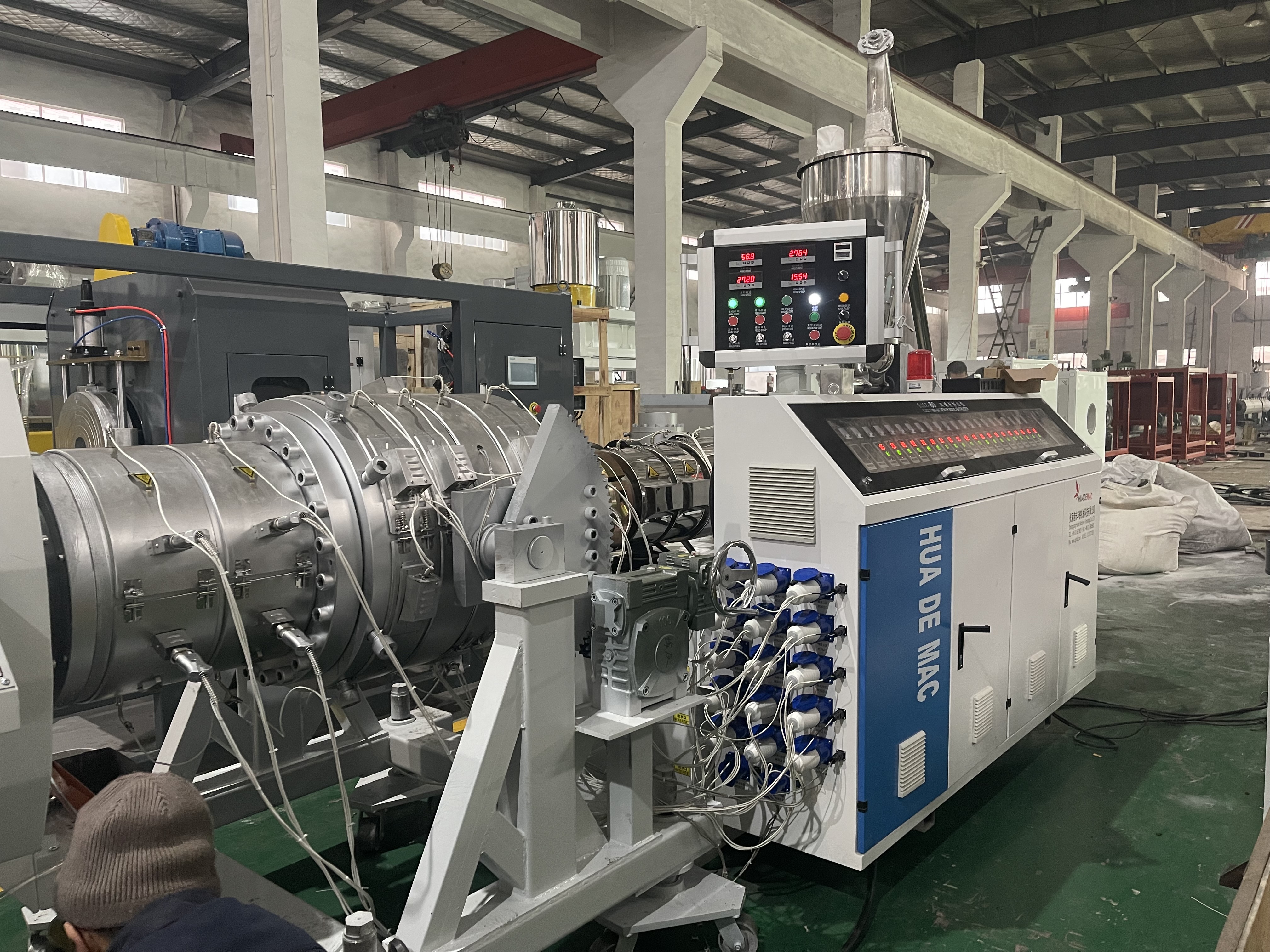
Conical or Parallel Twin-Screw Extruder: This component handles the core melting phase. It operates at intense temperatures ranging from 160°C to 200°C. You must leave a minimum three-meter clearance behind the gearbox. Maintenance teams need this space to pull the heavy screws out for cleaning.
Vacuum Calibration and Cooling Tanks: Hot plastic exits the die and enters sizing boxes. Water spray zones rapidly reduce the polymer temperature. Larger pipe diameters require exponentially longer cooling tracks. Without sufficient track length, you risk surface roughness and dimensional instability.
Haul-off (Traction) Unit: This machine pulls the rigid pipe forward. It uses variable frequency drives to match the extrusion speed perfectly. If your traction unit vibrates due to unlevel flooring, it causes wall thickness variations.
Planetary Cutter: The continuous pipe meets the cutting saw here. You should install dust-free cutting systems to maintain clean factory air. Leave ample space around the cutter for scrap collection bins.
End-of-Line Processing: The final stage involves stacker units for standard pipes. Alternatively, you might install a standalone PVC pipe belling machine. This machine handles automated socketing and expansion. It requires extra width in your floor plan to accommodate pipe rotation.
Facility zoning dictates how well your factory breathes. You must provide realistic baseline metrics for a mid-to-large scale facility before you pour concrete. Cramping your PVC pipe extrusion line into a tight space will cripple future expansion.
Micro-level footprint requirements are rigid. Each individual production line demands 15 to 40 meters of linear length. A small 20mm conduit line sits on the shorter end of this spectrum. A massive 630mm pressure pipe line requires the full 40 meters to accommodate extended vacuum cooling tanks.
Utility integration presents severe risks during the planning phase. Extruders and sizing tanks require robust, closed-loop industrial water chillers. You must plan trenching for these water lines before pouring your concrete foundation. Running above-ground hoses creates massive tripping hazards.
Heavy-duty equipment requires sophisticated 3-phase industrial power routing. Drop power lines from ceiling trays rather than routing them across the floor. Furthermore, you must control the ambient environment. Facilities should maintain a factory temperature between 18°C and 35°C. Uncontrolled ambient heat destabilizes polymer melting behavior and ruins product consistency.
Macro-Level Zone | Recommended Area (m²) | Primary Function |
|---|---|---|
Production Area | 1,500 – 3,000 | Houses primary extrusion machines, haul-offs, and auxiliary pathways. |
Raw Material Storage | 500 – 800 | Stores bulk PVC resin, calcium carbonate, stabilizers, and mixers. |
Finished Goods Warehousing | 300 – 600 | Holds stacked pipes, belling inventory, and dispatch loading bays. |
You must compare equipment configurations based on facility space and output targets. Solution categories generally split into single-cavity and dual-cavity systems. Your choice directly influences your layout blueprint.
Single-cavity lines offer excellent flexibility. Throughput typically ranges from 150 to 1,000 kg/hr. They allow for frequent die changes. You can easily switch between varying pipe diameters. However, single-cavity lines possess a notable downside regarding floor space. If you scale up by adding multiple single lines, your cumulative floor space requirements will skyrocket. Each new line requires its own dedicated clearance perimeter.
Dual-cavity lines (also known as two-cavity lines) solve strict spatial limitations. Throughput stretches from 150 to 1,200 kg/hr. These systems offer the absolute best yield-to-space ratio in the industry. A dual-cavity setup produces two pipes simultaneously from one single extruder. You effectively double your output without doubling the machinery footprint. It also means you only need one set of utility drops for power and chilled water. This configuration remains ideal for micro-scale units or heavily space-constrained facilities.
Feature | Single-Cavity Line | Dual-Cavity Line |
|---|---|---|
Output Range | 150 – 1,000 kg/hr | 150 – 1,200 kg/hr |
Footprint Efficiency | Moderate (Requires more total space per kg produced) | High (Maximized yield-to-space ratio) |
Production Flexibility | Excellent (Fast, simple die changes for different sizes) | Moderate (Best for continuous, high-volume single sizes) |
Utility Demands | Separate drops required for every line installed | Shared utility drops for twin pipe production |
Self-managed integration frequently fails. Plant managers often buy equipment from multiple, disconnected vendors to save upfront cash. This approach leads to severe spatial conflicts. Utility specifications rarely match up perfectly. Your cooling tank might require a 3-inch water inlet, while your main chiller only features a 2-inch outlet. These mismatched realities cause delayed commissioning. A proper commissioning phase should ideally take 6 to 10 days, not weeks.
The Turnkey or EPC (Engineering, Procurement, and Construction) approach removes these implementation headaches. Using a single vendor or engineering firm for end-to-end planning ensures cohesive footprints. The extruder, cooling systems, and downstream equipment will all share unified design logic.
You must also match your automation choices to your layout. Highly automated layouts feature inline QA scanners and robotic stacking arms. These advanced setups require less operational space for human movement. However, they demand much higher upfront capital. They also require wider technical clearance for opening robot safety cages during maintenance.
Apply strict logic when shortlisting suppliers. Demand a comprehensive 2D or 3D CAD layout of the machinery before you sign any contract. Ensure the vendor places their CAD models within your specific factory dimensions. They must clearly label all utility connection points. If a supplier refuses to provide custom layout schematics, you should walk away.
Planning your production layout is a critical engineering exercise. It dictates your long-term commercial viability. Rushing the floor design leads to wasted space, poor material flow, and dangerous working conditions. To ensure success, focus on these essential next steps:
Align your equipment choices carefully. Compare dual-line versus single-line footprints against your available square footage.
Finalize your target output in kilograms per hour before mapping physical space.
Embed utility infrastructure—like water trenches and power trays—into your foundation plans immediately.
Audit your floor space today and request customized CAD schematics from verified equipment manufacturers.
Making smart layout decisions upfront protects your margins. It is the most reliable way to achieve a highly profitable one-to-three-year payback period.
A: A typical line requires between 15 and 40 meters in length. This varies depending on the pipe diameter, the required length of the vacuum cooling tanks, and downstream additions like a PVC pipe belling machine.
A: Facilities should be climate-controlled to maintain an ambient temperature of 18°C to 35°C. This specific range prevents environmental interference with the sensitive plasticization and cooling processes.
A: A standard layout requires roughly 5 personnel per shift. This crew includes one lead operator, one assistant, one maintenance/electrical technician, one QA inspector, and one packaging operator.
A: Assuming the factory infrastructure (power, water, flooring) is completely prepared, standard installation and initial operator training typically take between 6 to 10 days.