Views: 0 Author: Site Editor Publish Time: 2026-06-02 Origin: Site

Selecting the right belling equipment is rarely a standalone decision; it acts as a critical exercise in continuous line synchronization. Manufacturers often face a harsh reality when mismatched speeds disrupt production workflows. If the belling cycle time lags behind, the entire upstream process must inevitably slow down. This mismatch erodes operational margins and severely limits daily output capacity. Conversely, over-speccing the socketing unit results in stranded capital and wasted factory floor space.
This dynamic creates a delicate balancing act for plant managers and engineers. Our comprehensive guide outlines a rigid evaluation framework to help you navigate this exact complexity. You will learn how to match socketing technology, diameter capabilities, and automation levels directly to your specific production requirements. We will also explore proven methods to maintain stringent compliance standards without sacrificing processing speed. Ultimately, you will gain actionable strategies to eliminate bottlenecks and optimize your pipe manufacturing floor.
Extrusion Sync is Mandatory: The belling machine’s cycle time (heating + forming + cooling) must strictly outpace the output speed of the upstream extrusion line to prevent bottlenecks.
Socket Type Dictates Tooling Complexity: R-Type (elastomeric ring) sockets require significantly more complex mandrel tooling and mechanical expansion than U-Type (solvent cement) sockets.
Diameter Ranges are Finite: Avoid "all-in-one" claims; optimal efficiency requires dedicating machines to specific diameter brackets (e.g., 16-63mm, 75-250mm) to minimize tooling changeover and heating waste.
Oven Configurations Determine Throughput: Thick-walled or high-speed pipes require double or multi-oven configurations to achieve uniform plasticity without burning the PVC surface.
Belling represents a batch process sitting at the very end of a continuous manufacturing chain. A core business problem arises when these two operational phases fall out of sync. If you cannot socket pipes fast enough, you face a tough choice. You must either drop the extruder speed or move unfinished pipes offline. Offline processing adds labor, risks surface damage, and disrupts lean workflows.
To avoid production backups, we must calculate cycle time constraints accurately. The math requires examining the raw output of your PVC pipe extrusion line.
Determine Extrusion Speed: Measure your line speed in meters per minute. For example, assume a line runs at 6 meters per minute.
Identify Pipe Length: Establish the cut length of the pipe. Assume standard 6-meter lengths.
Calculate Maximum Cycle Time: Divide the length by the speed. In this scenario, you produce one pipe every 60 seconds. The belling unit must finish heating, forming, and cooling within this strict 60-second window.
Wall thickness heavily impacts heating durations. Pipes carrying high SDR or PN ratings feature much thicker walls. They require deeper, slower heat penetration to reach the correct plastic state. If you run thick-walled pipes, a standard single-oven unit will quickly become the primary bottleneck.
You must choose between two distinct layout strategies based on your production volume.
In-Line Configurations: These systems integrate directly with the haul-off and cutting saw. They require perfect physical synchronization. Robust PLC communication ensures the belling unit knows exactly when a pipe arrives. This setup minimizes labor and maximizes continuous throughput.
Off-Line Configurations: These serve as a flexible fallback. Operators use them for specialized fittings or when handling overflow from multiple extruders. While they solve immediate bottleneck issues, off-line methods demand extra labor for material handling and secondary staging.
Best Practice: Always buffer your calculated cycle time requirement by 10% to account for ambient factory temperature shifts during winter months.
Your target market entirely dictates the type of socket you must produce. Each joint style demands vastly different mechanical approaches, tooling setups, and capital investments.
Contractors rely on U-Type sockets for low-pressure plumbing, standard drainage, and electrical conduit routing. The forming method utilizes a smooth core mandrel. The machine typically uses internal air pressure or external mechanical sizing sleeves to press the heated PVC against the mold.
In terms of implementation reality, U-Type processing remains highly efficient. You benefit from significantly faster cycle times. Tooling costs stay low, and routine maintenance proves highly simplified. Operators rarely struggle to calibrate these setups.
Municipalities require R-Type sockets for high-pressure water mains and deep underground sewer lines. The Rieber system serves as a prime industry example. Forming these joints requires highly complex, collapsible mechanical mandrels. These mandrels physically expand metal segments outward to form the precise internal groove designed to seat the rubber ring.
The implementation reality presents much harder engineering challenges. You face slower cycle times due to the complex mechanical movements. You must also commit to a significantly higher tooling investment. Dimensional tolerance requirements remain incredibly stringent; a deviation of a single millimeter causes catastrophic joint failure under hydrostatic pressure.
Telecommunication sectors often require non-standard profiles, including rectangular conduit sockets. These custom dies demand specialized engineering. Be prepared for extended tooling lead times and highly customized heating oven profiles to ensure uniform softening around sharp corners.
Feature | U-Type (Solvent Cement) | R-Type (Elastomeric Ring) |
|---|---|---|
Primary Application | Low-pressure drainage, electrical conduit | High-pressure water mains, sewer lines |
Tooling Complexity | Low (Smooth solid mandrel) | High (Collapsible mechanical mandrel) |
Average Cycle Time | Fast (Simple air blow or external sizing) | Slow (Multi-step mechanical expansion) |
Dimensional Tolerance | Standard | Extremely Stringent |
Maintenance Demand | Minimal (Fewer moving parts) | High (Regular lubrication of expanding segments) |
Many manufacturers fall for the myth of universal machines. A vendor might claim a single unit handles everything from 16mm up to 400mm pipes. Functionally, this proves highly inefficient. Excessive changeover times will continually destroy your daily production schedules. Furthermore, you waste massive amounts of electrical energy heating 16mm pipes in an oven scaled for 400mm dimensions. Sizing brackets must remain strategically dedicated.
Small Diameters (16mm - 63mm): These match extremely high-speed lines. They often require dual-pipe or four-pipe simultaneous belling units. A single-pipe unit simply cannot keep pace with the rapid output of small-diameter extruders.
Medium Diameters (75mm - 250mm): This represents the industry standard range. You usually rely on single-pipe processing here. The overall cycle time depends heavily on your specific oven setup and wall thickness ratings.
Large Diameters (315mm - 800mm+): These serve heavy-duty infrastructural lines. The operational focus shifts entirely from raw speed to precise heating. Multi-stage infrared arrays become absolutely necessary. Material handling and ejection mechanics also require heavy hydraulic automation.
Changeover economics play a massive role in operational efficiency. You must assess the realistic labor hours required to swap out equipment between runs. Operators must unbolt clamps, swap heavy heating molds, and meticulously align forming mandrels. Every hour spent on a changeover represents lost production yield. Dedicating specific machines to narrow diameter ranges minimizes these disruptive interventions.
Evaluating the leap from manual systems to automated technology requires looking deeply at output consistency. Semi-automatic units feature a lower initial capital expenditure. However, they carry dangerously high operator dependency. They remain prone to inconsistent socket quality because they rely on manual heating judgments. Operators often guess when the PVC pipe reaches the optimal elastic state. This methodology works for custom offline batches but fails miserably in continuous, high-speed runs.
Fully automatic systems eliminate this guesswork. They ensure strict, PLC-driven consistency. They communicate seamlessly with the rest of the factory floor. Upgrading to an automatic pipe belling machine standardizes your output quality and drastically reduces expensive scrap rates.
Rotary Heating: The machine continuously rotates the pipe inside the oven. This ensures uniform heat distribution across the entire circumference. It actively prevents pipe sagging and localized surface burning.
Multi-Oven Architecture: Modern units utilize dedicated pre-heating and final-heating stations. Splitting the heating load drastically cuts overall cycle times, especially for thick-walled high-pressure pipes.
Centralized PLC Controls: Advanced touchscreens allow direct integration with factory SCADA systems. You gain vital data logging capabilities for temperature profiles, cycle counts, and historical error rates.
Common Mistake: Buying a fast machine without upgrading the downstream cooling capabilities. Expanding the pipe rapidly does no good if the water chiller cannot set the plastic memory fast enough.
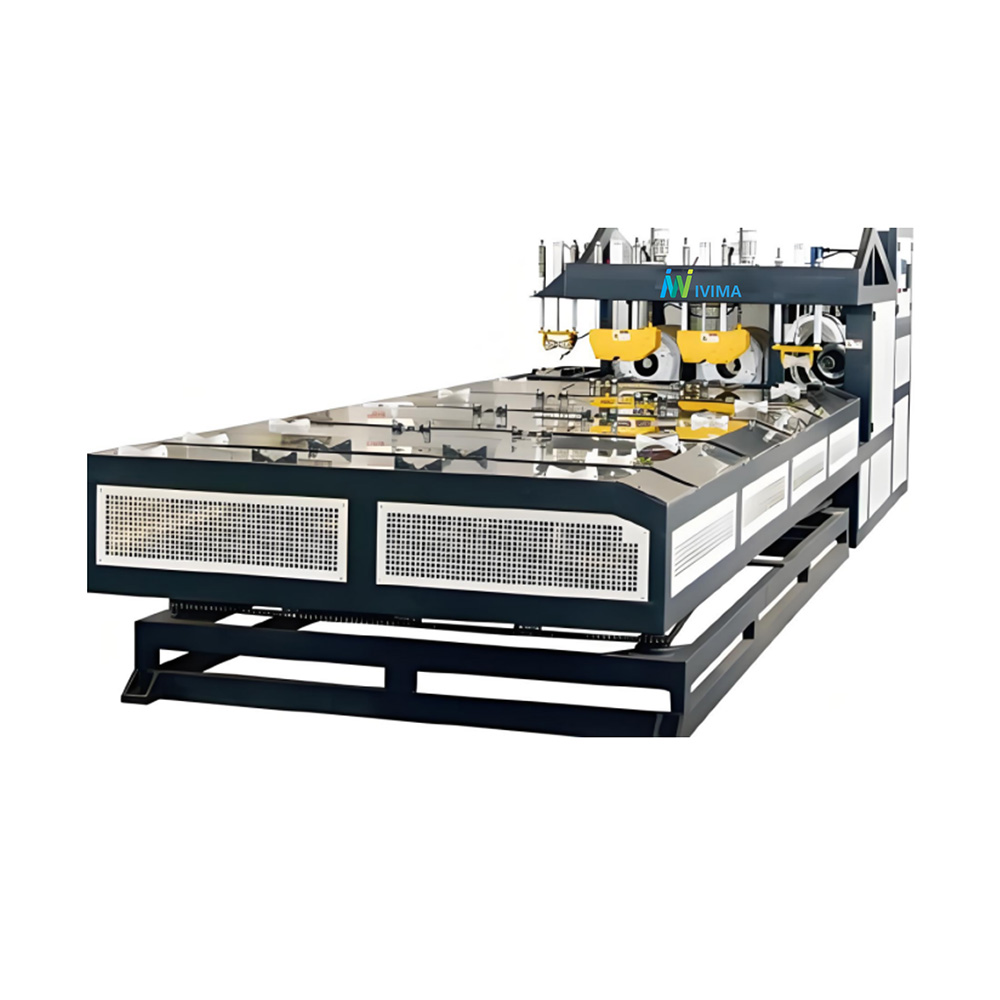
Planning your factory floor requires exact layout assumptions. A modern unit featuring dual ovens and a motorized ejection table adds substantial footprint length. It can easily add 4 to 8 meters to the end of an existing setup. You must leave adequate surrounding clearance for safe forklift access, maintenance walkways, and pipe bundling racks.
Hidden operational demands often catch plant managers off guard. Utility requirements scale up quickly. Consider your facility's electrical load. You will see a massive peak draw during the initial oven heating phase from a cold start. This eventually settles into a lower steady-state consumption. Your transformers must handle this initial spike without tripping breakers.
Pneumatics and hydraulics dictate mechanical stability. You need high-pressure, incredibly dry air for rapid cooling and external sizing operations. Hydraulic stability proves absolutely mandatory for R-type mechanical mandrel expansion. If the line pressure drops momentarily, the collapsible mandrel might fail to lock, resulting in a deformed gasket groove.
Cooling water acts as the final critical variable. You must calculate precise flow rates and dedicated chiller requirements. The chilled water must rapidly set the PVC memory immediately after the mechanical expansion finishes. Insufficient chilling capacity leads to socket shrinkage after ejection, ruining the joint dimensions.
Not all manufacturers possess the same engineering depth. You must evaluate their core technical expertise. Do they design their own belling tools in-house, or do they outsource them to third-party machine shops? Tooling precision dictates your entire operational success. It forms the exact difference between a passed or failed hydrostatic pressure test in the field.
Next, look closely at component verification. Assess the reliability of the off-the-shelf components they use. Vendors installing globally recognized brands like Siemens, Allen-Bradley, Festo, or SMC provide a distinct advantage. This ensures localized spare parts availability when a sensor or valve inevitably fails. You want a robust PVC pipe belling machine built with easily accessible, non-proprietary components.
Drafting strict Factory Acceptance Test (FAT) criteria protects your equipment investment before shipment. Demand the following parameters during the test:
Require the vendor to dry-run the machine using your specific factory pipe samples. Provide them with your exact SDR profiles and proprietary material formulations.
Measure the exact cycle time against their promised specification document using a stopwatch. Ensure they do not manipulate heating temperatures to artificially speed up the test.
Verify the dimensional accuracy of the finished socket. Use standard Go/No-Go gauges under varying ambient temperature states to ensure absolutely no post-cooling shrinkage occurs.
Test the emergency stop and PLC fault-recovery protocols to ensure the machine safely ejects half-heated pipes without jamming.
Treating the belling process as a critical capstone changes your operational perspective. It is never merely an afterthought accessory. Proper synchronization ensures the upstream line runs at maximum potential. By carefully matching socketing technology to your target market, you eliminate frustrating bottlenecks and reduce material waste.
Your next step requires data collection. Audit your current extrusion line speeds. Categorize your most profitable pipe diameters into the standard operational brackets discussed above. Finally, draft a strict technical specification sheet detailing your required socket types, cooling capacities, and cycle times. Bring this precise data to manufacturers to ensure a flawless equipment match.
A: Yes, but it requires purchasing separate tooling sets. You must swap out smooth mandrels for collapsible mandrels. Factoring in the mechanical changeover time is critical, as this process can significantly disrupt continuous production schedules.
A: This is usually caused by insufficient heating capacity. Operating a single oven instead of a double oven creates bottlenecks. Processing pipes with a thicker wall (lower SDR) than the machine's cycle time was originally rated for also causes major delays.
A: Air blowing uses internal pneumatic pressure to push heated PVC against an outer mold, which is common for simple U-Type joints. Mechanical expansion uses physical metal segments to stretch the pipe outward, a method necessary for creating precise R-type gasket grooves.