Language


Views: 0 Author: Site Editor Publish Time: 2026-05-29 Origin: Site


Global demand for flexible fluid transfer solutions is rising fast. You see this surge across agriculture, mining, and emergency response sectors. For manufacturers, capturing this growing market requires smart investments. You need equipment capable of high-yield, defect-free production. A modern, synchronized PVC lay flat hose machine bridges this critical gap. It connects raw material efficiency directly to premium market output.
This guide deconstructs the complete manufacturing process. It covers essential material handling requirements and operational capabilities. You will learn what an industrial production setup requires to succeed. We explain how to remain highly competitive. We also cover compliance for stringent quality standards. Understanding these mechanical factors ensures your operation delivers consistent results. You will discover actionable insights to optimize your manufacturing floor efficiently.
Core Technology: Advanced production relies on one-step co-extrusion and synchronized weaving to eliminate adhesives and prevent delamination under pressure.
Material Versatility: Profitable lines must efficiently process 100% virgin PVC, high-tenacity polyester yarns (e.g., 1100D), and precise additive ratios.
Buyer’s ROI: Evaluating a Plastic Pipe Machine requires assessing automation levels, inline quality control (QC) integration, and the ability to meet diverse application demands (from 2-bar agricultural use to heavy-duty industrial discharge).
To understand the final product, buyers must first dissect the equipment architecture. This machinery creates the classic three-layer hose anatomy. It includes a smooth inner tube, a tough reinforcement layer, and a protective outer cover.
Extruders form the absolute foundation of the production system. They require exceptional precision regarding temperature control. Operators typically maintain melt temperatures strictly between 160°C and 190°C. This exact thermal range ensures uniform wall thickness across the entire batch. It also guarantees optimal chemical resistance in the final product. If temperatures fluctuate, the PVC compound degrades. This degradation causes hidden weak spots along the hose wall.
This weaving mechanism acts as the critical midpoint of the machinery. Cross-weaving or spiral braiding of polyester yarn happens precisely here. The specific weave pattern dictates the maximum burst pressure of the hose. A synchronized unit ensures the yarn wraps perfectly around the hot inner tube. It prevents uneven tension constantly. Uneven tension often leads to premature hose rupture during field deployment.
Water cooling troughs play a vital role in long-term structural integrity. Manufacturers design them specifically to prevent inner stress and surface wrinkling. Haul-off equipment then pulls the continuous hose through the line steadily. Operators calibrate these traction belts carefully. They maintain perfect circularity during the critical cooling phase. This structural control ensures the hose flattens flawlessly upon pressure release later.
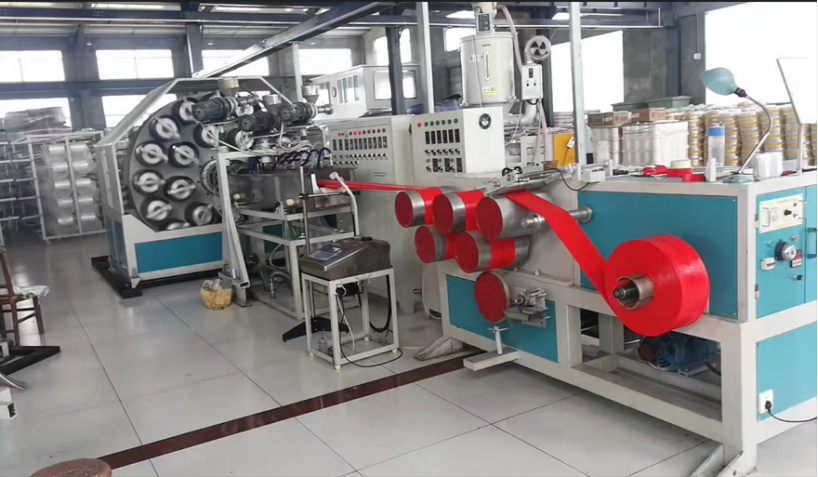
The manufacturing process begins with precise chemical mixing. Operators combine PVC resin, plasticizers for flexibility, UV stabilizers, and colorful pigments. They use high-speed, temperature-controlled mixers for this phase. These specialized mixers maintain temperatures precisely between 120°C and 130°C. Proper dry blending ensures a highly consistent raw material feed. It drives off excess moisture before extrusion begins.
Best Practice: Always store your dry-blended PVC compounds in climate-controlled silos for 24 hours. This resting period stabilizes the plasticizers. It prevents inconsistent melting during extrusion.
Modern systems utilize a continuous one-step forming process. This advanced method fundamentally changes structural integrity. The simultaneous inner and outer extrusion pushes liquid material directly through the woven mesh. It creates a highly homogeneous, fully integrated structure. This specific delamination-proof design outperforms older, adhesive-based manufacturing methods. The layers fuse physically rather than chemically.
Cooling involves much more than simply lowering the surface temperature. Extended water-cooling baths lock in permanent dimensional stability. They prevent tiny micro-fractures from forming inside the PVC matrix. Gradual, staged cooling ensures the plastic sets evenly. Some advanced lines use vacuum sizing tanks. This technology maintains perfect geometry before the hose eventually flattens.
The final manufacturing step focuses heavily on finishing and packaging. Inline surface printing adds essential branding, pressure ratings, and batch tracking codes. Automated coiling systems then spool the flattened hose continuously. They configure it for standard commercial lengths, such as 50m or 100m. Advanced tension control mechanisms prevent unwanted creasing during packaging. Creases often cause weak points during storage.
A premium production setup processes diverse thermoplastic compounds effortlessly. It must handle 100% virgin PVC flawlessly during long runs. Virgin material remains critical for extended lifespan and high-pressure ratings. The system should also process eco-friendly or bio-based alternatives smoothly. It must do this without compromising overall machine throughput or end-product quality.
Tension management systems are completely non-negotiable here. They handle industrial-grade continuous polyester filaments, such as the widely used 1100D yarn. Precise tension control achieves high safety margins consistently. It balances the Working Pressure (WP) and Burst Pressure (BP) perfectly. Poor tension control always creates twisted or warped hoses.
Common Mistake: Using mismatched yarn spools creates uneven radial tension. Always load spools from the same manufacturing batch onto the circular weaving unit.
Regional markets frequently demand highly specific chemical formulations. Your equipment must manage various additives seamlessly. This includes handling imported pigments for extreme fade resistance. It also involves mixing anti-abrasion agents and specialized cold-resistant plasticizers. These precise adjustments meet specific geographic or harsh industrial requirements effectively.
Different global markets require highly specific hose characteristics. You must connect your machine's tuning capabilities directly to final market applications. Adapting extrusion speed and yarn tension helps you serve multiple industries effectively.
Farming applications strictly demand lightweight, highly flexible hoses. These water hoses need extremely low friction loss internally. This smooth interior allows rapid deployment over massive agricultural fields. Operators tune extruders to produce thinner, highly flexible walls. They optimize output for maximum meterage per hour.
Harsh industrial environments dictate vastly different physical specifications. Mining operations require extruding significantly thicker outer covers. These rugged covers must feature exceptionally high abrasion resistance. They survive rough, rocky terrain and continuous chemical exposure daily. Extruders run slower to ensure optimal layer thickness.
Flood relief and municipal firefighting rely on massive fluid movement. You must manufacture large-diameter, high-volume discharge hoses. These specific products must withstand sudden, violent pressure spikes. Heavy-duty braiding and highly robust co-extrusion are mandatory for this application.
Application Field |
Wall Thickness Requirement |
Reinforcement Type |
Key Performance Focus |
|---|---|---|---|
Agriculture & Irrigation |
Thin to Medium |
Standard Cross-Weave |
Flexibility & Low Friction |
Mining & Construction |
Thick (Heavy Duty) |
High-Density Spiral Braid |
Abrasion & Chemical Resistance |
Emergency Dewatering |
Medium to Very Thick |
High-Tenacity Mesh |
Burst Pressure Resilience |
Output speed matters heavily, but never at the absolute cost of quality. You must evaluate output speed carefully. Always weigh meters per minute against the risk of wall thickness variations. Pushing a machine too fast often causes the inner layer to stretch unevenly. High speeds require highly responsive extruder temperature controls to prevent this stretching.
Common Mistake: Do not rely solely on the theoretical maximum speed printed on brochures. Always test throughput consistency during actual continuous operation.
Modern manufacturing facilities rely heavily on highly automated systems. Inline defect monitoring drastically reduces costly scrap rates. Automated tension control lowers manual labor costs significantly. A fully integrated industrial hose production line ensures fewer operational bottlenecks. It keeps the factory running efficiently across all shifts.
Global market demands shift rapidly. You must assess how quickly the system can switch between different product parameters. You might need to change production diameters from 1-inch to 6-inch quickly. Adjusting pressure ratings from 2 bar to 8 bar must remain seamless.
Many buyers transition directly from traditional rigid pipe manufacturing. They quickly learn that evaluating flexible hose equipment differs vastly from evaluating a standard Plastic Pipe Machine. Flexible hose lines demand complex, synchronized coordination between the extruder and the weaving unit.
Reliable hardware requires equally reliable, long-term vendor support. Buyers should demand highly transparent factory acceptance tests (FAT) before shipment. Comprehensive installation training is also absolutely essential for your local operators. Ensure you have accessible spare parts for critical extrusion components. This preparation keeps operational downtime to an absolute minimum.
Quality control cannot be an afterthought in flexible hose manufacturing. High-end equipment capabilities should actively support strict international testing standards.
Your inline and offline testing equipment should strictly cover these five critical dimensions:
Burst & Impulse Testing: This simulates aggressive operational fatigue. It tests the hose against sudden, extreme pressure changes common in industrial pumps.
Adhesion Testing: This proves the co-extrusion bond strength objectively. It measures the physical lock between the melted PVC layers and the woven polyester yarn.
Tensile Strength & Flexibility: This test verifies overall structural integrity. It ensures the hose performs well across extreme bend radiuses without cracking.
Temperature/UV Tolerance: Accelerated aging tests are highly vital. They accurately predict the lifespan of the hose during prolonged, intense outdoor deployment.
Dimensional Verification: This step relies heavily on inline laser gauges. These precise sensors monitor diameter and wall thickness continuously during the extrusion process.
Profitable PVC lay flat hose manufacturing ties directly to advanced machinery precision. The physical accuracy of your chosen co-extrusion and weaving setup dictates final product quality completely. Consistent wall thickness and strong layer adhesion define market leaders.
Here are the essential steps for moving forward:
Prioritize equipment offering high automation and proven, long-term dimensional stability.
Ensure the machinery adapts easily to rapidly varying market demands. It should switch seamlessly from standard irrigation requirements to high-spec mining applications.
Integrate highly robust inline quality control sensors to minimize material waste and aggressively protect your brand reputation.
We strongly encourage you to take the next practical step. Request a technical consultation to discuss your specific factory manufacturing needs. Download a detailed machine specification sheet to compare power consumption, floor footprint, and overall yield metrics objectively.
A: A standard pipe machine extrudes rigid, unreinforced plastics continuously into a fixed shape. A lay flat hose machine requires highly synchronized weaving or braiding units. It utilizes a complex one-step co-extrusion process to encapsulate a flexible polyester mesh firmly between inner and outer PVC layers. This creates a fully collapsible, high-pressure structure.
A: The equipment uses an advanced one-step co-extrusion process. Extruders push the inner and outer PVC layers simultaneously through the woven mesh layer. The high melt temperatures fuse the layers together instantly. This strong physical lock completely eliminates the need for messy adhesives and prevents delamination under pressure.
A: Production speeds vary significantly based on hose diameter and specified wall thickness. For small agricultural hoses (1-inch to 2-inch), speeds typically range from 10 to 20 meters per minute. Heavy-duty, large-diameter industrial hoses (4-inch to 6-inch) require slower processing, usually running between 3 and 8 meters per minute.
A: Yes, a highly versatile machine can produce both distinct types. However, this transition requires adjustable die heads and advanced yarn tensioners. Operators must switch chemical formulations and adjust cooling capacities accordingly. High-end machines offer rapid changeover features, allowing facilities to pivot between different pressure ratings efficiently.


