Views: 0 Author: Site Editor Publish Time: 2026-05-12 Origin: Site

Rising demand for lightweight conduit and drainage solutions heavily reshapes municipal and industrial manufacturing today. Modern infrastructure projects increasingly depend on flexible, durable piping to meet strict environmental and performance standards. Plant managers and investors face a continuous balancing act. You must maintain high production speeds while ensuring excellent material efficiency. You also need to manage capital expenditures carefully when expanding factory capacity.
This guide provides a clear, evidence-based evaluation framework. We focus directly on engineering realities, application-specific requirements, and long-term operational efficiency. You will discover how to match machinery specifications to your target end-use markets. We also explore ways to prevent common extrusion bottlenecks on the factory floor. Ultimately, you will learn how to confidently evaluate equipment vendors and select a system capable of delivering consistent, high-quality pipe profiles.
Material Efficiency: Single wall corrugated designs save up to 60% of raw material compared to solid-wall pipes while maintaining structural integrity via ring stiffness.
Application-Driven Specs: Machinery configurations must be tailored: electrical conduits require high-speed coiling for small diameters (16–32mm), while drainage applications demand precise vacuum forming for larger diameters (up to 110mm+).
Evaluation Focus: The viability of a corrugated pipe machine hinges on extruder screw design (L/D ratios), vacuum pressure stability (-0.03 to -0.08 MPa), and mold-changeover efficiency.
Risk Mitigation: Addressing common production bottlenecks—such as uneven wall thickness and cooling inefficiencies—prior to procurement reduces unplanned downtime.
Investing in corrugated pipe technology fundamentally transforms your material economics. The secret lies in the geometric folding of the pipe wall, commonly called the "accordion effect." This clever geometry creates substantial ring stiffness. It allows manufacturers to reduce raw material usage by approximately 60% compared to traditional solid PVC or PE pipes. You achieve the required structural integrity without relying on brute material thickness. This reduction directly lowers your unit costs and boosts overall profit margins.
Market demand drivers strongly favor corrugated designs over legacy concrete or solid plastic alternatives. End-users consistently prefer these pipes for two primary reasons:
Labor and Installation: Workers experience a 90% weight reduction during transport and handling. Highly flexible pipe bodies eliminate the need for complex, expensive elbow joints. You can navigate trenches and obstacles easily, speeding up installation times.
Lifecycle Performance: These pipes boast high resistance to chemical corrosion and UV degradation. They reliably deliver 50-year lifespans. This longevity easily meets the most stringent municipal procurement standards.
Production scalability acts as another major factor for high ROI. Standard output equipment typically runs at 4 to 12 meters per minute. However, high-speed lines can push limits up to 25 meters per minute. You must frame your capital investment against output capacity and cost-per-meter. High-speed systems require a larger initial outlay but drastically lower the time required to fulfill bulk orders.
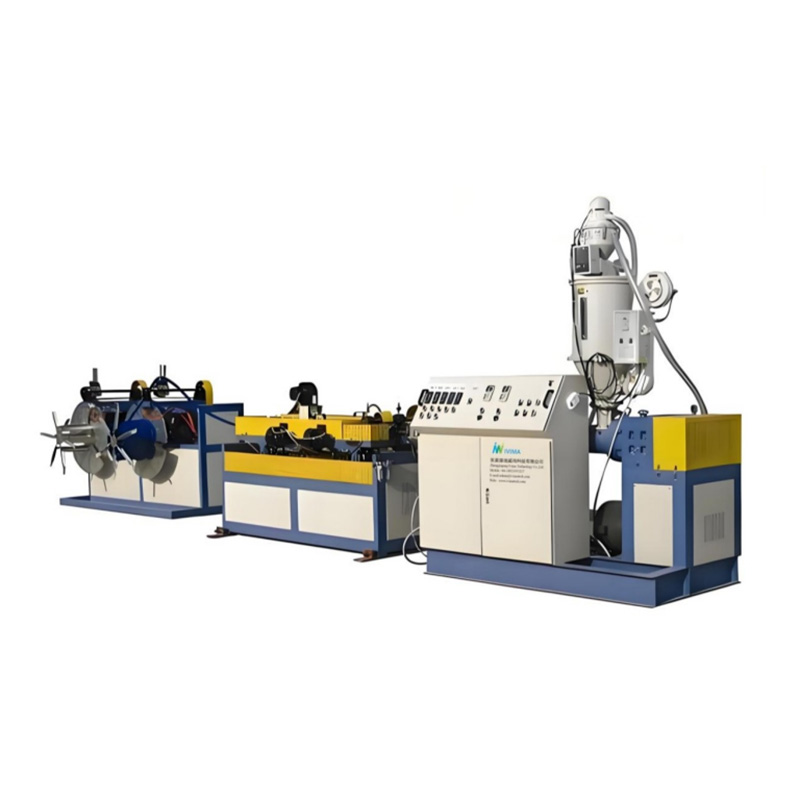
Moving from general benefits to specific market applications reveals an important truth. Your manufacturing equipment must adapt seamlessly to the final product's purpose. A versatile Plastic Pipe Machine handles distinct processing parameters depending on whether it produces small electrical conduits or large drainage pipes.
Electrical conduits demand precision at high velocities. Production requirements dictate high-speed extrusion processes. Manufacturers often rely on ceramic or infrared heating zones to maintain exact melt temperatures. Material focus remains firmly on PE, PP, or PA (Polyamide). These materials offer the high flexibility and heat resistance necessary for safe cable housing.
Downstream handling for these small diameters requires specialized integration. You need dual-station winders to manage rapid output without halting the line. Additionally, chipless cutters are mandatory. They ensure smooth, burr-free edges. Rough edges easily cause cable abrasion during installation, which leads to immediate product rejection.
Agricultural and municipal projects demand entirely different machine capabilities. Production requirements shift toward robust vacuum forming systems. You need deep, consistent corrugation to ensure the pipe withstands heavy soil load bearing. Structural failure underground is not an option.
We must also acknowledge important engineering realities regarding application limits. Single wall pipes naturally possess higher internal friction than double-wall alternatives. Contractors must apply specific installation slopes to prevent debris buildup and clogging. You must communicate these flow dynamics to your buyers.
Downstream handling shifts dramatically for larger profiles. Coilers become impractical. Instead, you integrate cut-to-length planetary cutters and automated stackers to manage the rigid 110mm+ pipe segments efficiently.
Choosing the right equipment determines your long-term success. You must evaluate any single wall corrugated pipe production line using a strict framework. This prevents costly mismatches between machine specs and production goals.
Screw design forms the heart of your operation. You must assess single-screw extruders featuring L/D ratios between 25:1 and 30:1 for processing HDPE and PP resins. Alternatively, conical twin-screw extruders remain essential for processing PVC powder efficiently. Do not compromise on metallurgy. Nitrided steel components, specifically 38CrMoAlA, represent the baseline requirement for superior wear resistance against abrasive polymer melts.
Cooling systems dictate your maximum line speed. You must evaluate air cooling versus water cooling designs. Standard lines often use air. However, high-speed lines absolutely require internal water cooling loops inside the mold blocks. Water rapidly sets the plastic and locks the corrugated ridge structure before it deforms.
Changeover efficiency impacts your uptime heavily. Look for horizontal modular designs. They allow your operators to execute rapid mold swapping. Minimizing downtime between diameter changes keeps your factory output high.
Manual intervention invites human error. Insist on Tier-1 PLC components from brands like Siemens or Omron. These systems accurately monitor melt temperatures between 170°C and 230°C. They also maintain critical line speed synchronization across the extruder, corrugator, and haul-off units.
Below is a summary chart comparing standard versus high-speed system expectations:
System Type | Speed (m/min) | Cooling Method | Primary Application | Automation Level |
|---|---|---|---|---|
Standard Line | 4 – 12 | Air / Ambient | Standard PVC / Custom short runs | Basic PLC |
High-Speed Line | 15 – 25 | Internal Water Loops | High-volume PA / PE Conduits | Advanced Tier-1 PLC (Siemens/Omron) |
Even premium equipment occasionally encounters operational hurdles. Floor experience teaches us how to identify and resolve these issues rapidly. A high-quality machine prevents many problems, but operators must stay vigilant.
Irregular Corrugation Profile: This defect almost always stems from fluctuating vacuum pressure. If the ridges appear shallow or malformed, check the vacuum pump. A reliable system must maintain stable vacuum levels strictly between -0.03 and -0.08 MPa.
Uneven Wall Thickness: Operators trace this back to inconsistent melt pressure or poor die head design. It compromises ring stiffness and wastes material. Precision gear pumps and perfectly synchronized haul-off speeds act as mandatory corrections for this issue.
Thermal Degradation: Burning plastic destroys the product batch. You must rely on precise PID temperature control to prevent overheating. This proves especially critical when processing heat-sensitive materials like PVC.
By establishing rigorous daily checks on these three parameters, you protect your machinery investment and maintain strict quality control.
A structured procurement approach eliminates costly surprises. You must align physical factory constraints with the technical specifications of your newly chosen corrugated pipe machine.
First, define your production matrix. Map your required pipe diameters against target production speeds (measured in kg/hr or m/min). This calculation determines the necessary main motor power. Over-specifying wastes capital; under-specifying bottlenecks your growth.
Second, prioritize standardization and compliance. Ensure the line produces pipes that easily meet international testing standards. For example, buyers will expect your pipes to pass ASTM D2412 for ring stiffness. If the machine cannot hold tight tolerances, your product fails testing.
Third, conduct a vendor support assessment. Evaluate the supplier's spare parts availability. Specifically, check inventory for consumable heating elements and cutter blades. Ensure the vendor provides remote diagnostic capabilities to troubleshoot PLC faults instantly.
Here is a strategic planning table to guide your vendor discussions:
Evaluation Phase | Key Action Items | Critical Metrics to Verify |
|---|---|---|
Capacity Mapping | Map pipe diameters to required extrusion speeds. | Motor kW rating, output in kg/hr. |
Compliance Check | Review mold designs against global pipe standards. | ASTM D2412 (Ring Stiffness tolerances). |
Vendor Verification | Audit spare parts inventory and service level agreements. | Availability of cutter blades and heating bands. |
Your actionable next step requires moving beyond spec sheets. Recommend requesting a live trial run with your specific resin mix. Finally, conduct a localized power compatibility check to confirm whether your factory supports 220V, 380V, or 415V requirements.
Investing in advanced corrugated pipe extrusion technology fundamentally requires balancing maximum output speed with perfect geometric precision. Your success relies on matching extruder L/D ratios, mold cooling capacities, and automation controls to your specific end-product needs.
Remember, achieving the highest extrusion speed means little if you suffer constant downtime. Minimizing interruptions through quick-change horizontal mold systems and reliable vacuum stability proves just as important as raw throughput. Focusing on robust material handling and tight quality control ensures long-term profitability.
Take the next logical step toward scaling your operations. Consult with an experienced extrusion engineer today. Request a customized technical proposal tailored exactly to your resin type, pipe diameter requirements, and factory floor footprint.
A: Standard lines operate at 4–12 m/min, meaning they produce roughly one meter every 30 to 60 seconds. High-speed configurations can achieve 20–25 m/min depending on the pipe diameter and the efficiency of the mold's internal water cooling capacity.
A: Single wall manufacturing utilizes one extruder and a single forming process, producing a pipe corrugated on both the inside and out. Double-wall manufacturing requires two extruders (co-extrusion). It fuses a smooth inner layer to a corrugated outer layer, primarily serving heavy-duty underground municipal drainage.
A: While the downstream corrugator can handle multiple materials, the extruder screw design must specifically match the resin. PE and PP require a single screw extruder. PVC typically requires a conical twin-screw extruder. Switching materials often means swapping the entire extruder or changing the screw profile.
A: Routine maintenance focuses on cleaning mold blocks thoroughly, lubricating the corrugator drive chains, and calibrating the vacuum pumps. You must also regularly replace worn cutter blades. Standardizing your spare parts inventory remains highly recommended to prevent prolonged operational halts.