Views: 0 Author: Site Editor Publish Time: 2026-11-27 Origin: Site
Manufacturers often reach a critical crossroads when expanding their industrial hose portfolios. They must choose between investing in braided fiber or steel wire embedded production lines. Both machines serve the highly competitive flexible tubing market. However, their manufacturing processes, capital requirements, and end-user applications differ dramatically. Selecting the right equipment goes far beyond evaluating basic output capacity. You must align your machine specifications to meet strict product compliance standards. For example, high-pressure pneumatic hoses require completely different mechanical setups compared to heavy-duty vacuum-suction tubes. Navigating operational complexities during extrusion is also vital to maintaining profitable yield rates. This article provides a detailed comparative analysis of the mechanical, operational, and financial realities involved. We will explore how to configure a PVC reinforced hose extrusion line properly. Plant managers and factory investors will gain the exact knowledge needed to make a highly evidence-based machinery acquisition.
Fiber braided lines are optimized for high-pressure applications and require precise synchronization between inner/outer extruders and the braiding matrix.
Steel wire lines focus on vacuum and suction resistance, demanding specialized wire forming and synchronous embedding mechanisms within the die head.
Capital expenditure (CapEx) and footprint requirements vary; fiber lines generally require longer cooling troughs and more floor space due to the multi-stage extrusion process.
Procuring plastic pipe and hose machinery requires evaluating vendor track records on layer adhesion technologies (for fiber) and wire tension control (for steel).
Equipment return on investment depends heavily on matching your production capabilities to specific industry demands. Before purchasing machinery, you must firmly grasp the daily realities of your target buyers. A mismatch between your equipment and customer requirements leads directly to unsold inventory. By defining your market early, you ensure your extrusion line produces exactly what distributors need.
Fiber-braided hoses see massive demand in pneumatics, agriculture spraying, and pressurized fluid transfer. Success in these sectors relies entirely on high burst-pressure ratings. End-users demand hoses capable of handling sudden pressure spikes without rupturing. Furthermore, flexibility remains a core requirement. Workers constantly bend and drag these hoses across factory floors and agricultural fields. If the hose kinks or stiffens, productivity drops.
Conversely, the heavy-duty market demands structural rigidity. Chemical transfer facilities, food-grade processing plants, and agricultural vacuum trucks rely heavily on steel-reinforced products. Here, success relies on crush resistance and vacuum integrity. When industrial pumps create strong suction, standard hoses collapse inward. A dedicated PVC steel wire hose extrusion line produces tubing capable of resisting this extreme negative pressure. Many buyers also require anti-static properties to safely transport abrasive powders or volatile chemicals.
Many plant managers attempt to purchase modular machines capable of switching between fiber and wire production. We strongly advise against this approach. Attempting modular changeovers introduces unacceptable downtime. Operators must completely swap die heads, recalibrate tensioners, and adjust cooling flumes. More importantly, frequent changeovers introduce severe die-head alignment risks. You risk compromising uniform wall thickness for both product types. Investing in distinct, dedicated lines usually proves far more profitable and operationally stable over time.
Producing a braided hose requires a carefully orchestrated, multi-stage manufacturing sequence. The process combines polymer science and textile engineering. Understanding these stages helps you identify potential bottlenecks before finalizing an equipment purchase.
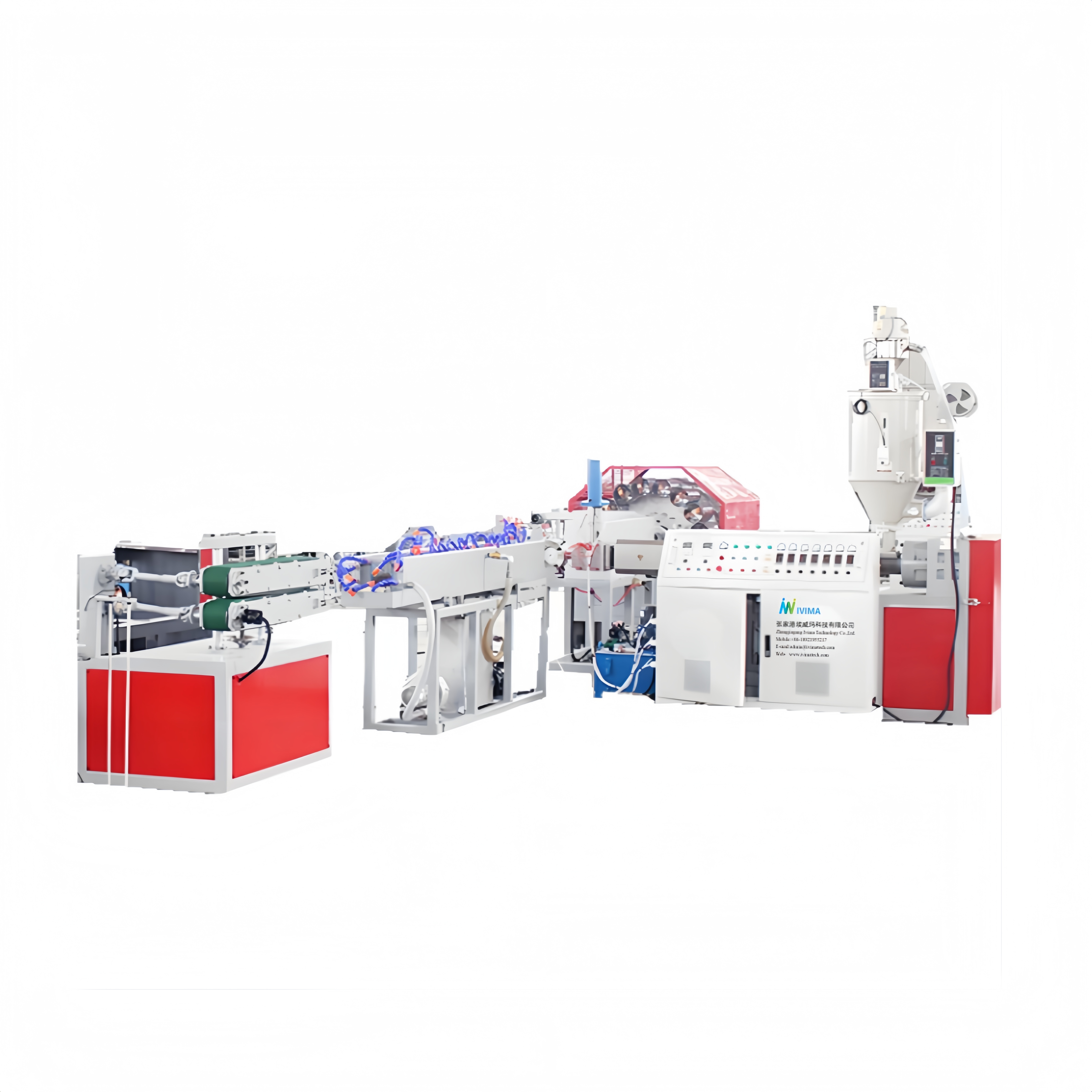
A standard PVC fiber reinforced hose extrusion line follows a strict sequential flow to ensure product integrity:
Inner tube extrusion
First stage water cooling
Braiding process (usually applying polyester or cotton yarn)
Oven drying and surface heating
Outer layer PVC extrusion
Final stage water cooling
Haul-off pulling and coiling
Your choice of braiding machine directly dictates the final burst pressure. Manufacturers evaluate braiders based on carrier counts, typically choosing between 24, 36, or 48-carrier models. A 24-carrier unit suits smaller pneumatic hoses. Conversely, large agricultural transfer hoses demand 48-carrier braiders to weave a sufficiently dense mesh. You must match your braider specifications to your target hose diameter and industry pressure standards.
The intermediate oven heating stage is absolutely critical. After the braider wraps the yarn around the inner PVC tube, the hose enters a heating tunnel. This oven softens the inner tube's exterior skin. When the hose passes through the second extruder, the molten outer PVC layer bonds directly through the yarn gaps into the softened inner layer. This molecular bonding prevents catastrophic delamination when the hose faces extreme internal field pressure.
Fiber lines depend entirely on advanced Programmable Logic Controller (PLC) systems. You must maintain exact tension and speed across three distinct extrusion stages simultaneously. If the haul-off pulls slightly faster than the first extruder, the inner tube stretches and thins out. If the braider lags, the mesh density drops. Advanced PLCs prevent hose deformation by constantly talking to all motor drives and adjusting speeds in real time.
Unlike the multi-stage fiber process, wire embedding happens in a single, simultaneous operation. This setup demands intense precision right at the die head. The machinery focuses primarily on metal forming and plastic encasement rather than textile weaving.
The operational sequence for wire-reinforced production is much more condensed:
Wire payout from a spool
Spring forming and shaping
Simultaneous PVC extrusion and wire embedding
Prolonged water cooling
Haul-off pulling and final coiling
The specialized coiling machine acts as the heart of this line. It pulls raw spring steel from a massive spool and shapes it into a continuous, perfectly pitched spiral. It then feeds this spinning metal spring directly into the back of the extrusion die head. The timing must remain flawless. Any hesitation in the wire feed immediately ruins the internal structure of the hose.
Single-step extrusion encases the spinning wire uniformly. The die head engineering prevents the wire from drifting off-center. Equal wall thickness on both the inside and outside of the wire prevents structural weak points. If the inner wall becomes too thin, the wire protrudes into the fluid path, causing clogs or contamination. If the outer wall is too thin, dragging the hose will expose the wire to rust.
You must adapt these lines for varied chemical formulations. Food-grade clear PVC requires specialized stainless steel contact parts to avoid contamination. Furthermore, transporting dry powders creates dangerous static electricity. For anti-static compounds, operators often insert a secondary copper wire alongside the steel spring. Your chosen machinery must comfortably handle these diverse raw materials without requiring major mechanical overhauls.
Comparing financial outlays helps investors budget accurately. You must look past the initial sticker price and evaluate long-term running costs. Factory footprint constraints also play a massive role in equipment selection.
Machinery Financial and Setup Comparison
Comparison Metric | Fiber Braided Line | Steel Wire Line |
|---|---|---|
Capital Expenditure (CapEx) | Higher initial cost. Requires two separate extruders, a braiding machine, and an intermediate oven. | Generally lower initial cost. Utilizes a single main extruder alongside a wire forming unit. |
Operational Expenses (OpEx) | Higher energy consumption due to dual extruder heating zones and oven. Yarn is generally cheaper. | Lower energy consumption. Spring steel raw material costs fluctuate based on global metal markets. |
Floor Space Requirements | Requires 25 to 35 meters of linear floor space. Needs multiple cooling flumes between stages. | Highly compact. Requires only one prolonged cooling stage after the single die head. |
Yield Rates & Throughput | Higher meters-per-hour output. Standard lines run quickly due to the pliable nature of yarn. | Lower meters-per-hour output. The mechanical wire feeding process limits maximum safe line speeds. |
When procuring plastic pipe and hose machinery, you must weigh these variables carefully. Fiber setups demand a larger initial investment and a longer factory floor. However, they offset this with faster production speeds. Steel wire lines fit easily into cramped factories and use less electricity, but they produce fewer meters per hour.
Every extrusion process carries inherent manufacturing risks. Preparing for these hurdles prevents excessive scrap rates and field failures. Operational success relies on understanding exactly what can go wrong during a high-speed production run.
Yarn breakage is your most common enemy on a braided line. A single snapped thread compromises the entire burst-pressure rating, causing immediate production scrap. Operators must watch yarn bobbins constantly. Secondly, insufficient bonding temperature in the intermediate oven leads to disastrous layer separation. If the outer layer fails to bond, the hose will bubble and burst under field pressure, leading to expensive product recalls.
Wire tension loss causes the spiral pitch to become irregular. If the spiral spacing widens, the hose loses its vacuum resistance and collapses under suction. Furthermore, operators must monitor cooling baths rigorously. Internal moisture entering the tube during the cooling phase causes premature wire oxidation. Rust developing inside a brand-new hose ruins a manufacturer's reputation instantly.
You cannot swap operators between these lines casually. Fiber lines require personnel highly skilled in textile tension calibration and mechanical braider maintenance. They must know how to splice yarn quickly. Wire lines, however, require staff skilled in precise die-head tuning. They must possess the mechanical aptitude to troubleshoot aggressive wire-feed jams and calibrate heavy steel rollers.
Modern industrial markets enforce strict regulatory standards. Selling into the medical, food, or pharmaceutical sectors requires FDA, REACH, or RoHS compliance. Upgrading machinery to meet these standards adds complexity. You may need stainless steel contact parts, automated laser micrometers for wall-thickness verification, and advanced vision systems to catch microscopic defects. Factor these compliance modifications into your initial machinery discussions.
Transitioning from research to procurement requires a structured approach. Approaching equipment vendors without a concrete plan leaves you vulnerable to purchasing mismatched machinery. Use a methodical evaluation strategy to protect your investment.
Drafting a comprehensive Request for Quotation (RFQ) is your first defensive step. Never ask vendors for "standard" machine prices. Build your RFQ around exact requirements. List your required minimum and maximum hose diameters. Specify your target output capacities in kilograms per hour. Explicitly state target certifications like FDA food-grade compliance. A detailed RFQ forces vendors to provide accurate, customized engineering proposals.
Prioritize manufacturers who offer total transparency. The best vendors gladly host Factory Acceptance Testing (FAT). You should physically inspect the machine running your specific raw materials before authorizing final shipment. Post-installation support is equally critical. Ensure the vendor provides comprehensive on-site operator training and guarantees quick access to spare parts like replacement braider carriers or wire forming rollers.
To finalize your machinery acquisition process, execute the following actions immediately:
Calculate expected production volume vs. machine output: Determine how many shifts you plan to run. Compare this against the vendor's stated meters-per-minute capability to ensure you can meet customer lead times.
Assess existing factory floor layout: Grab a tape measure. Verify you have the continuous linear space necessary for long cooling flumes, especially if purchasing a multi-stage fiber line.
Request sample output data: Ask shortlisted equipment providers to send physical hose samples produced on their machines. Subject these samples to aggressive burst-pressure or vacuum-collapse tests in your own facility.
Expanding your flexible tubing portfolio requires a strategic approach to machinery selection. Both production setups offer distinct commercial advantages. Fiber braiding prioritizes extreme pressure handling through a multi-stage extrusion and weaving process. Conversely, steel wire embedding focuses on providing unbeatable suction integrity through precision die-head encasement.
Your final verdict hinges on a rigorous evaluation of your target buyer's specific end-use applications. Analyze your available capital closely, and measure your factory's footprint accurately. By matching your operational capacity to the specific complexities of these extrusion lines, you guarantee a smoother installation, higher yield rates, and an ultimately profitable manufacturing venture.
A: No. The fundamental extrusion processes—multi-stage with a mid-line braider vs. single-stage simultaneous die-head embedding—require dedicated and fundamentally different machinery layouts.
A: Fiber lines typically run faster (e.g., 10–20 meters per minute depending on diameter) compared to steel wire lines (e.g., 3–10 meters per minute), though actual speeds depend heavily on extruder capacity and cooling efficiency.
A: Fiber lines require two separate cooling stages (after inner extrusion and after outer extrusion), necessitating longer water troughs. Steel wire lines generally require only one prolonged cooling stage after the initial die head.
A: Regular calibration of the wire forming rollers, monitoring of wire feed tension, and cleaning of the specific die-head channels to prevent polymer burning around the wire entry point.