Views: 0 Author: Site Editor Publish Time: 2026-11-13 Origin: Site
Downstream defects in PVC processing almost always originate in the mixing phase. Poor dry blending leads directly to inconsistent plasticization. You often see material bridging in the hopper or experiencing sudden mechanical failures. Many facility managers treat PVC dry blend preparation simply as a basic chemical recipe. However, you must view this operation as a highly sensitive thermomechanical process. It relies completely on precise sequencing and robust equipment capability. If you mix materials randomly, your extruders will suffer. In this technical guide, we break down the correct addition order step by step. We also examine how advanced mixer engineering affects batch stability. Mastering these variables remains non-negotiable. Manufacturers need these practices to reduce cycle times and minimize expensive additive waste. Properly prepared batches ensure a perfectly stable feed for your extrusion or pelletizing lines.
Sequential Precision: The addition order (Resin → Stabilizers → Plasticizers/Lubricants → Fillers) is dictated by resin porosity and temperature, not convenience.
Thermal Management: Effective hot mixing ensures additive absorption at specific temperature thresholds (typically peaking around 110°C–130°C), while rapid cold mixing prevents thermal degradation and agglomeration.
Equipment ROI: Investing in an optimized PVC mixer machine directly dictates batch consistency, utility costs, and the operational lifespan of downstream extrusion equipment.
Downstream Protection: A homogeneous dry blend is the primary safeguard against surging and rapid screw wear in subsequent processing lines.
Let us examine the real business problems caused by improper mixing. Manufacturers waste expensive additives like titanium dioxide and tin stabilizers every single day. Operators also end up rejecting final products because of poor color dispersion or weak impact resistance. These costly problems stem directly from bad sequencing in the mixing room.
We must understand the physical structure of PVC resin particles. They are not solid, smooth spheres. Instead, they feature highly porous structures resembling microscopic sponges. As the temperature rises inside the mixing vessel, these resin pores begin to open. They require this specific heat application to absorb liquid additives effectively. If the pores remain closed, liquids simply pool on the particle surface.
If you ignore the proper sequence, you invite immediate production disasters. A major mistake involves premature lubrication. Adding lubricants too early coats the raw PVC particles completely. This premature waxy coating seals the open pores shut. Consequently, the resin cannot absorb crucial stabilizers and plasticizers later in the cycle. You inevitably produce brittle, highly defective batches.
Common signs of sequence failure include:
Severe color variations across the final extruded profile.
Unmelted resin particles appearing as "fish eyes" on the product surface.
Excessive smoke or outgassing at the extruder die head.
Rapid buildup of burnt material on the extruder screw flights.
Operators require a strict standard operating procedure for compounding. You cannot guess the addition order based on operator convenience. Instead, you must follow specific temperature triggers.
Addition Sequence Temperature Chart
Processing Step | Material Added | Temperature Range | Primary Action |
|---|---|---|---|
1 | Resin & Stabilizers | Ambient to 60°C | Prevents thermal degradation. |
2 | Plasticizers & Aids | 60°C to 90°C | Absorbs into open pores. |
3 | Lubricants | 90°C to 100°C | Coats particles after absorption. |
4 | Fillers & Pigments | 100°C to 110°C+ | Mixes without absorbing liquids. |
Always load your PVC resin into the vessel first. Begin the mixing cycle at a low speed. Introduce your heat stabilizers very early in the process. High-speed mechanical shear from the mixing blades generates intense frictional heat quickly. This heat threatens to degrade unprotected PVC molecules. Stabilizers protect the raw resin from thermal degradation during this aggressive initial heating phase. They neutralize hydrochloric acid released during early friction.
Wait patiently until the resin reaches its optimal porosity. This physical change usually happens right around 60°C. Now you can safely add liquid plasticizers. The open, unsealed pores will soak them up efficiently. Rapid absorption prevents the liquids from pooling at the bottom of the pot. At this exact stage, you should also introduce processing aids. Acrylic processing aids promote faster fusion when the material eventually reaches the extruder.
Internal and external lubricants perform critical functions during extrusion. However, you must add them only after the resin fully absorbs the plasticizers. If you dump lubricants in earlier, they coat the particles and seal them prematurely. Wait until the batch hits 90°C. Internal lubricants will reduce melt viscosity. External lubricants will prevent the hot melt from sticking to the hot metal surfaces of your extruder.
Introduce abrasive fillers and dry pigments last. Calcium carbonate acts exactly like sandpaper inside your stainless steel vessel. Adding it late minimizes significant wear and tear on the mixer blades. Crucially, late addition prevents these dry fillers from soaking up valuable liquid additives. Those liquids are meant exclusively for the PVC resin. If calcium carbonate absorbs the plasticizer, your final product becomes stiff and brittle.
Finally, discharge the completed batch to the cooling mixer. Depending on whether you run a rigid or flexible formulation, discharge temperatures usually land between 110°C and 130°C.
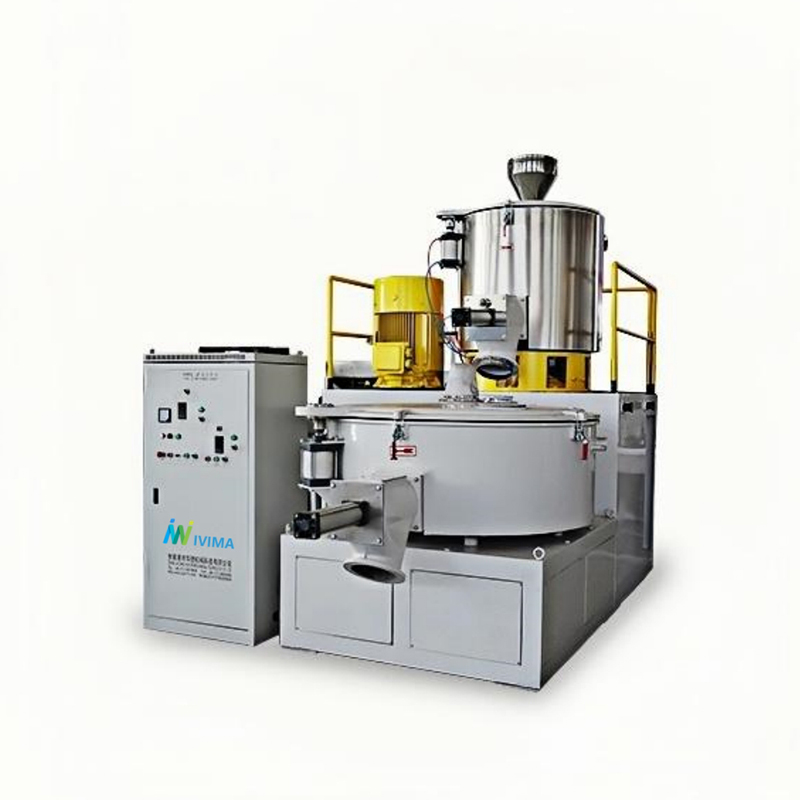
Successful compounding requires a rapid, controlled thermal transition. You must move the hot batch from high-shear heating to low-shear cooling instantly. This dynamic transition is where dual-stage equipment truly proves its worth.
Intense frictional heat drives the entire hot mixing phase. High-speed impeller blades aggressively agitate the solid particles. This intense mechanical friction heats the material far more efficiently than external vessel heating jackets. Frictional heating guarantees uniform temperature distribution across the entire batch volume. External heating often scorches the material touching the vessel walls.
Once the batch reaches its target temperature, the cooling phase begins immediately. You must rapidly transfer the hot blend into the cooling unit. The primary goal is to drop the batch temperature below 45°C to 50°C as quickly as possible. This rapid cooldown removes residual moisture effectively. It absolutely prevents the warm blend from caking or agglomerating inside your storage silos later. Most importantly, immediate cooling completely stops any early plasticization of the resin.
Synchronizing these two crucial phases eliminates frustrating production bottlenecks. Operating a high-quality hot and cold PVC mixer reduces your overall cycle times significantly. The cooling cycle often takes longer than the heating cycle. Therefore, efficient cooling keeps your downstream processing lines running without unexpected interruptions. You maximize output while protecting material integrity.
What separates a standard, entry-level unit from a high-performance system? Facility managers need to look at specific, verifiable engineering metrics. A well-built PVC mixer machine transforms your entire manufacturing operation. Let us break down the critical decision-stage criteria you must evaluate.
Blade geometry and wear resistance matter immensely to your uptime. The impeller design must create a proper, aggressive vortex. A strong vortex pulls dry material down the center and forces it up the vessel walls. Because fillers like calcium carbonate are highly abrasive, standard steel blades degrade very quickly. Look for mixing blades coated in tungsten carbide or specialized ceramic materials. These hard coatings withstand harsh daily compounding routines.
Cooling jacket efficiency dictates your daily output rate. Traditional water ring cooling systems often struggle to drop temperatures fast enough. You should contrast this older approach against advanced multi-zone cooling jackets. Multi-zone systems offer vastly superior heat transfer surface areas. Better heat transfer always equals much shorter cycle times. Shorter cycle times mean you produce more batches per shift.
Drive systems significantly impact your daily energy consumption. Older belt and pulley systems drain electrical power inefficiently. The modern plastics industry now heavily favors direct-drive or inverter-controlled motors. Hot mixing requires massive motor torque during the initial startup phase. Inverter controls intelligently reduce severe energy spikes during this high-torque period. They also provide smoother acceleration for the heavy material load.
Automation and PLC controls eliminate costly operator errors entirely. Manual dumping relies on human timing. Human timing varies wildly from shift to shift. You need fully automated dosing systems for liquid additives. You also need temperature-triggered pneumatic discharge valves. These smart features guarantee batch-to-batch repeatability every single time. They remove the guesswork from compounding.
Mixer Component Evaluation Matrix
System Component | Standard Specification | High-Performance Specification |
|---|---|---|
Impeller Blades | Stainless Steel | Tungsten Carbide / Ceramic Coated |
Cooling Jacket | Basic Water Ring | Multi-Zone Baffle Cooling |
Motor Drive | Belt and Pulley | Direct Drive / Inverter Controlled |
Discharge Valve | Manual / Timer-Based | PLC Temperature-Triggered |
The quality of your prepared dry blend directly dictates overall plant profitability. You simply cannot isolate the mixing room from the rest of the factory floor. Bad mixing amplifies problems at every subsequent machine.
Consider the massive impact on your PVC pipe extrusion line. A moisture-free, free-flowing dry blend completely prevents material bridging in the feed hopper. When raw material flows smoothly, extruder head pressure remains incredibly stable. This mechanical stability drastically reduces wall thickness variations during pipe manufacturing. You produce more sellable pipe and generate significantly less scrap. You also maintain strict dimensional tolerances effortlessly.
The exact same rules apply to a PVC compounding pelletizing line. Consistent additive dispersion completely prevents material surging inside the pelletizer unit. The extruder screws grab the homogeneous material evenly. You secure uniform pellet geometry across the entire run. This uniformity reduces customer reject rates down to zero. High-quality pellets demand premium prices in the market.
Cutting corners on your mixing unit invites massive operational risk. Poorly mixed batches always contain unabsorbed abrasive fillers and uneven lubrication. This inconsistency predictably results in severe, accelerated wear. Unlubricated calcium carbonate will scour the inside of your extruders. You will find yourself replacing expensive twin-screw extruder barrels and screws much earlier than expected. Protect your major extrusion investments by mixing the material correctly first.
Successful PVC processing relies heavily on two foundational pillars. First, you must strictly adhere to the correct additive addition sequence. Second, you must aggressively leverage the thermal efficiency of your mixing equipment. Without both elements working together, downstream product quality suffers immediately.
Take action today to improve your compounding process:
Audit your current mixing cycle times to identify hidden cooling bottlenecks.
Evaluate your mixer blade wear rates and schedule immediate maintenance if you spot dull edges.
Request specific cooling efficiency metrics when shortlisting new mixing machinery for your plant.
Train your operators on the exact temperature triggers required for each additive phase.
Following these practical steps protects your heavy equipment investments. You will see immediate, measurable improvements in batch consistency and overall production yield.
A: Rigid PVC is typically discharged from the hot mixer between 115°C and 125°C. This temperature window ensures all additives are fully incorporated into the resin. It achieves optimal dispersion without initiating premature fusion before extrusion.
A: Agglomeration usually points to inefficient cooling. If the blend discharges from the cold mixer above 50°C, it remains too warm. Inadequate moisture evacuation during the cooling phase also causes the hot blend to sweat, leading directly to caking in silos.
A: Adding Calcium Carbonate (CaCO3) too early acts exactly like a sandblasting agent inside the vessel. These abrasive particles circulate at high speeds, drastically reducing the operational lifespan of the stainless steel pot and the impeller blades.
A: Realistic benchmarks are 8 to 12 minutes for hot mixing and 10 to 15 minutes for cooling. Cycle times vary based on batch size, motor power, and cooling water temperature. The slower cold mixer often dictates the overall line speed.