Language


Views: 251 Author: Site Editor Publish Time: 2026-02-08 Origin: Site


The global demand for durable, cost-effective construction materials has placed PVC profile extrusion lines at the heart of modern manufacturing. Whether it is window frames, door panels, or intricate decorative moldings, the ability to produce high-quality profiles consistently is a competitive necessity. However, the transition from raw PVC resin to a finished product requires more than just heat; it demands a precise mechanical synergy.
In this guide, we dive deep into why the twin-screw process has become the industry benchmark. We will explore how an industrial PVC profile extrusion line operates, the specific mechanical advantages of different screw configurations, and where these profiles provide the most value in today’s market. If you are looking to optimize your production efficiency or understand the technical backbone of PVC manufacturing, this breakdown is for you.
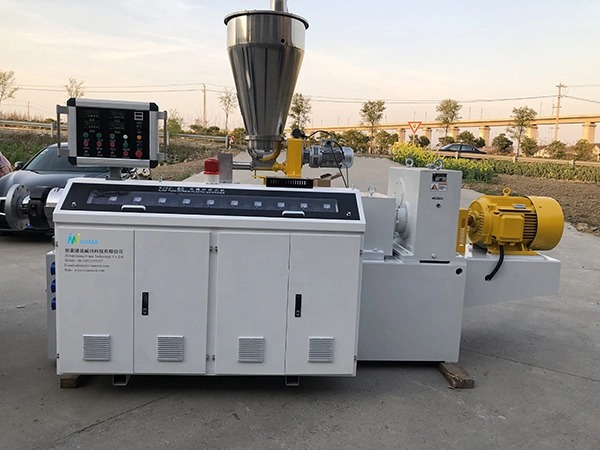
At the core of any high-performance PVC profile extrusion line lies the twin-screw extruder. Unlike single-screw models, twin-screw systems provide superior mixing and pressure control, which are vital for PVC—a material notoriously sensitive to heat.
The conical twin-screw design is particularly favored in PVC profile extrusion lines for several reasons. At the feed end, the large diameter allows for a high volume of powder intake. As the material moves toward the die, the diameter decreases, naturally compressing the melt. This geometry ensures:
Uniform Plasticization: It prevents "hot spots" that could degrade the PVC.
High Torque: The design handles the high viscosity of PVC resin efficiently.
Energy Efficiency: It requires less external heating because the mechanical shear generates much of the necessary thermal energy.
While conical versions are common for standard profiles, a high speed parallel twin-screw setup is often used for massive industrial outputs. These screws maintain a constant diameter, allowing for longer residence times and higher pressure stability. They are the workhorses of industrial PVC profile extrusion lines where volume and continuous operation are the primary KPIs.
Investing in a modern PVC profile extrusion line is not just about making products; it is about maximizing margins through technical superiority. Modern lines are designed to minimize waste and maximize uptime.
| Feature | Benefit to Manufacturer |
| Automatic Control Systems | Reduces labor costs and minimizes human error in temperature settings. |
| High Speed Calibration | Increases throughput without compromising the dimensional accuracy of the profile. |
| Wear-Resistant Screws | Extends the lifespan of the PVC profile extrusion line, reducing maintenance downtime. |
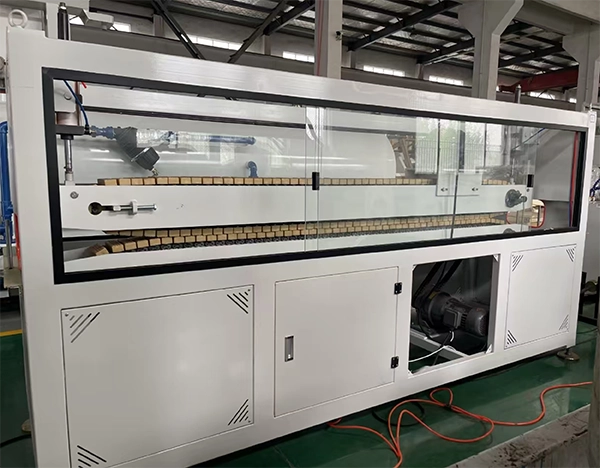
The most significant benefit remains consistency. A high speed PVC profile extrusion line utilizes advanced vacuum cooling tables. These tables "freeze" the profile into its exact shape the moment it leaves the die. Without this precision, profiles would warp, leading to high scrap rates and wasted raw materials.
A complete industrial PVC profile extrusion line is a complex assembly of synchronized machinery. Understanding each stage helps operators troubleshoot and optimize the flow.
Accuracy starts before the heat is applied. Automatic weighing and feeding systems ensure that the PVC resin and additives (like UV stabilizers and impact modifiers) are mixed in the exact ratio. Even a 1% deviation can ruin the structural integrity of the final profile.
The die gives the PVC its soul. In a PVC profile extrusion line, the die must be engineered with high-precision flow channels. Following the die is the vacuum calibration tank. Here, water spray and vacuum pressure work together to ensure the multi-layer or solid profile meets strict tolerances within fractions of a millimeter.
The haul-off unit must pull the profile at a speed perfectly synchronized with the extruder’s output. If it pulls too fast, the profile thins; too slow, and it bunches up. Finally, an automatic saw or cutter slices the profiles to length, ready for packaging.
The versatility of PVC profile extrusion lines allows manufacturers to serve multiple sectors. Because PVC is resistant to corrosion and moisture, its applications are vast.
Construction: This is the biggest market. Window profiles, siding, and door frames produced on a high speed PVC profile extrusion line offer better insulation than aluminum.
Electrical: PVC trunking and cable trays provide non-conductive, fire-resistant housing for wiring.
Agricultural: Durable fencing and irrigation components are often extruded using industrial grade setups.
We are also seeing a rise in multi-layer PVC profile extrusion. This process uses a co-extrusion die to combine different materials. For example, a manufacturer might use recycled PVC for the core and a virgin, UV-resistant PVC layer for the exterior. This approach significantly reduces costs while maintaining a premium appearance.
When configuring a PVC profile extrusion line, the orientation of certain components can change based on factory space and product type.
In most industrial PVC profile extrusion lines, a horizontal layout is standard because it allows for long cooling troughs. However, a vertical cooling or stacking approach is sometimes used in specialized, space-constrained environments or for specific small-scale profiles.
Vertical integration often refers to the software side as well—where the automatic sensors feed data directly into a central management system. This "vertical" data flow allows for real-time adjustments to screw speed or zone temperatures, ensuring the PVC profile extrusion line operates at peak performance 24/7.
The push for "Industry 4.0" has transformed the modern PVC profile extrusion line. Automation is no longer a luxury; it is a requirement for staying competitive.
In the past, increasing the extruder speed often meant the cooling system couldn't keep up. Modern high speed lines solve this with enhanced vacuum pumps and "turbulent flow" water cooling. This allows the PVC profile extrusion line to run up to 30-50% faster than models from a decade ago.
A smart PVC profile extrusion line monitors the torque on the conical twin-screw. If the torque spikes, the system identifies a potential blockage or cold-start issue and alerts the operator. This automatic oversight prevents catastrophic screw breakage, which can cost tens of thousands of dollars in repairs.
While "PVC" is the headline, these lines are often capable of handling variations like WPC (Wood Plastic Composite) or UPVC (Unplasticized PVC).
Multi-layer technology is a game-changer. By using two or three extruders feeding into a single die, a PVC profile extrusion line can produce a "sandwich" profile.
Outer Layer: High-end aesthetic finish with color and UV protection.
Core Layer: Often made of foamed PVC or recycled material to reduce weight and cost.
Inner Layer: Designed for structural rigidity.
This capability makes the industrial PVC profile extrusion line an incredibly flexible asset for any factory, allowing them to pivot from budget-friendly products to premium architectural components with minimal hardware changes.
The evolution of PVC profile extrusion lines has turned a complex chemical process into a streamlined, automatic science. By leveraging the twin-screw process—specifically the conical twin-screw for its superior mixing—manufacturers can produce high-quality, multi-layer profiles at a high speed that was once impossible. Whether you are producing industrial cable ducts or residential window frames, the key to success lies in choosing a line that balances power with precision.
Q: Why is a twin-screw extruder better than a single-screw for PVC?
A: PVC powder does not flow easily and is heat-sensitive. The twin-screw design provides positive displacement and better shear control, ensuring the material melts evenly without burning.
Q: Can a standard PVC profile extrusion line produce WPC (Wood Plastic Composite)?
A: Yes, many industrial lines are compatible with WPC, though you may need a specific conical twin-screw design and additional venting to handle the moisture in the wood fibers.
Q: What is the average lifespan of a high-quality PVC profile extrusion line?
A: With proper maintenance and automatic monitoring, the main structure can last 15-20 years. However, the screws and barrels are "wear parts" and typically need replacement or refurbishment every 2-5 years depending on the abrasiveness of your PVC formula.
Q: How does a multi-layer setup save money?
A: It allows you to use cheaper, recycled materials in the center of the profile while keeping the visible surface looking brand new. This can reduce raw material costs by up to 25%.
Would you like me to create a detailed technical specification table comparing different conical twin-screw models for your next project?


