Views: 0 Author: Site Editor Publish Time: 2026-06-09 Origin: Site

Investing in recycling infrastructure shifts your operational focus from waste generation to material recovery. This transition creates sustainable workflows. It also supports mandatory environmental compliance goals. However, maximizing the efficiency of this equipment requires moving far beyond basic installation. Many facility managers struggle to achieve consistent material purity. They often experience frequent equipment downtime due to improper operational handling.
Whether you are deploying consumer-facing collection units or integrating a full-scale industrial processing facility, knowing how to correctly operate, calibrate, and maintain your equipment is critical. Poor operation leads to contaminated outputs. Contamination drastically reduces the usability of your recycled plastics. This guide breaks down the essential operational workflows and technical integration steps. You will learn the strict maintenance protocols required to run commercial and industrial plastic recycling systems efficiently. We outline exactly how to configure collection interfaces, operate heavy-duty granulation lines, and establish rigorous daily maintenance schedules for maximum uptime.
Dual-Ecosystem Operations: "Using" a recycling machine varies heavily by scale—from configuring retail Reverse Vending Machines (RVMs) for accurate container identification to managing high-throughput industrial granulators.
Purity is Profit: In commercial operations, correct use of a PET bottle washing line is the primary differentiator between low-value flake and premium, food-grade rPET.
Preventative Maintenance Prevents Downtime: Consistent calibration of optical sensors and timely blade replacements in shredders are mandatory for maintaining advertised throughput capacities.
Vendor Evaluation: Shortlisting equipment requires matching machine capacity (kg/hr) and footprint with your facility’s actual collection volume and utility constraints.
Operating a recycling network requires understanding two entirely different ecosystems. Front-end collection relies on Reverse Vending Machines (RVMs). Retailers and public venues use these units to collect empty beverage containers directly from consumers. Back-end processing involves massive industrial shredding and washing lines. Recycling plants use these lines to transform raw plastic bales into clean, reusable flakes.
We define successful operation differently across these two environments. For collection systems, success means continuous uptime and strict compliance with local Deposit Return Schemes (DRS). You must collect containers efficiently while preventing fraud. For processing systems, success hinges entirely on material purity and continuous throughput. You must strip away contaminants and separate distinct polymer types accurately.
Operator training requirements also diverge significantly. Front-end terminal staff need basic retail training. They learn how to clear minor jams and replace receipt paper. Conversely, operators running heavy industrial lines require specialized electromechanical knowledge. They must understand fluid dynamics for washing tanks and safely perform complex lock-out/tag-out procedures during equipment maintenance.
System Category | Primary Function | Operator Skill Level | Primary Success Metric |
|---|---|---|---|
Front-End Collection (RVM) | Consumer container intake and sorting | Basic / Retail Staff | High uptime and DRS compliance |
Back-End Processing | Shredding, washing, and purifying plastics | Advanced / Industrial Technicians | Material purity and output volume |
Reverse Vending Machines serve as the crucial first touchpoint in the plastic recycling loop. Proper setup ensures smooth consumer experiences and accurate data reporting.
You must configure the machine’s database before allowing public access. The RVM software relies on a comprehensive barcode registry. It cross-references inserted items against eligible DRS products. You must also calibrate the integrated shape recognition cameras and weight sensors. These sensors detect residual liquid inside bottles. Rejecting heavy bottles prevents sticky liquid spills inside the compaction chamber. This step effectively eliminates fraud and non-recyclable contamination at the source.
Staff members must follow a structured daily routine to keep RVMs operational. The workflow includes several specific tasks:
Monitoring interface alerts: The dashboard displays real-time bin capacity. Staff should proactively empty bins before they hit 100% capacity to prevent out-of-service errors.
Safe extraction: Workers must use proper ergonomic techniques to remove heavy bins filled with compacted material. They should immediately secure the bags to prevent material spillage.
System replenishment: Staff must regularly replace thermal receipt rolls. They must also verify digital payout network connectivity to ensure users receive their deposit refunds instantly.
Even highly calibrated machines face contamination issues. The machine’s rejection mechanism simply pushes ineligible items back out to the user. Consumers frequently abandon these rejected items on or near the machine. Staff must perform hourly sweeps to clear abandoned trash. You should place dedicated general waste and manual recycling bins directly next to the RVM. This best practice drastically reduces immediate area littering.
Industrial processing transforms massive bales of collected bottles into uniform plastic flakes. This environment demands strict attention to staging, safety, and operational flow.
Workers begin by loading baled or loose bottles onto the main infeed conveyor. Bales require automated bale breakers to loosen the tightly packed bottles. Once loosened, the material travels through trommel screens. These rotating cylindrical screens filter out loose debris, rocks, and dirt. Next, magnetic separators pull ferrous metals from the stream. You must monitor these preliminary sorting stages closely. Failing to remove debris heavily damages the downstream shredding blades.
Modern plants utilize automated optical sorters. You must calibrate the NIR (Near Infrared) sensors to identify specific polymer signatures accurately. These sensors trigger precise jets of air. The air jets blow non-PET items off the high-speed conveyor belt. Proper calibration allows the system to separate valuable PET from HDPE caps and PVC labels automatically. You should test sensor accuracy daily using a controlled batch of mixed plastics.
The core size-reduction step happens inside the granulator. Operating a heavy-duty Plastic Recycling Machine requires constant vigilance. Operators must monitor the feed rates meticulously. Feeding material too quickly causes severe motor overloads and triggers emergency shutdowns. A consistent, moderate feed ensures the rotary blades cut the plastic into uniform flakes. Uniformity is critical for the subsequent washing stages.
Shredding plastic only changes its physical size. To achieve commercial-grade output, you must thoroughly sanitize the material. Industrial washing removes biological contaminants, sugary residues, and chemical adhesives.
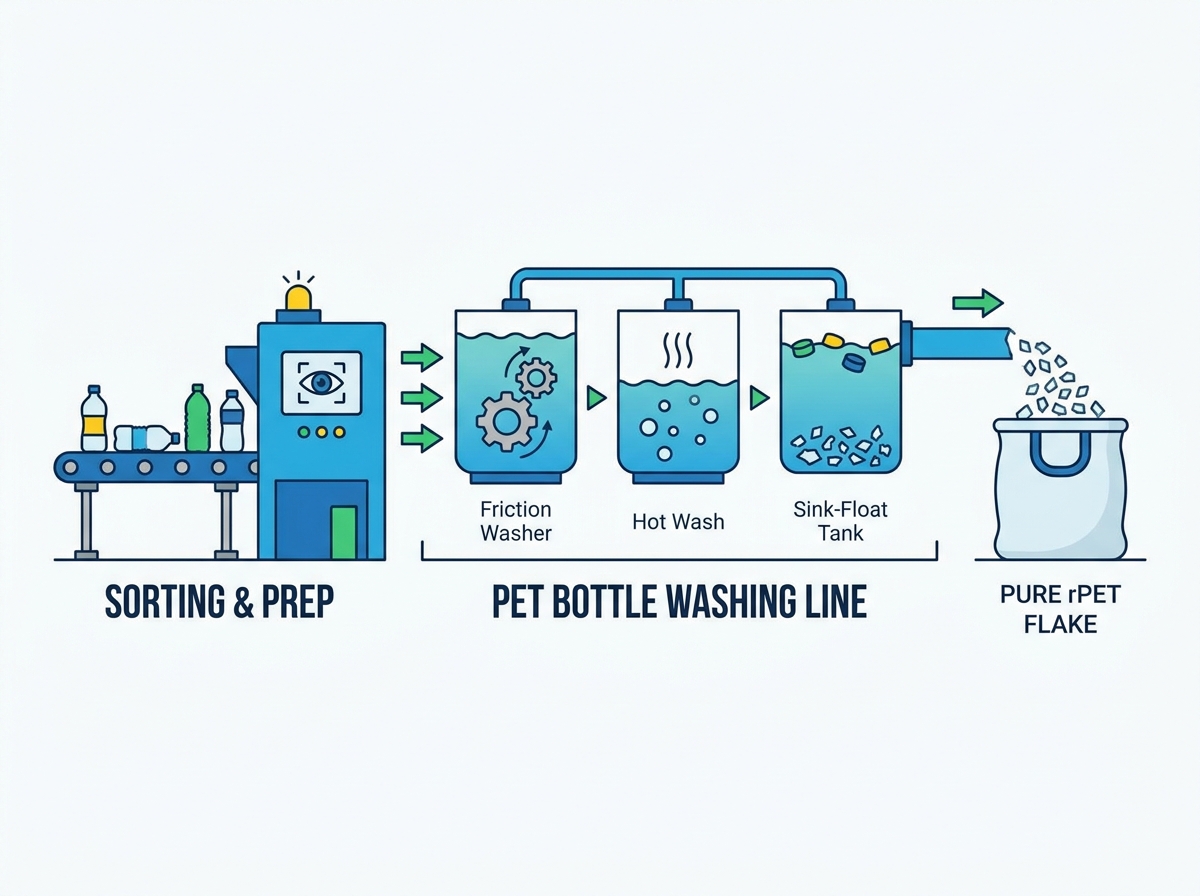
Raw flakes carry sticky labels, toxic glues, and strong odors. Deploying a dedicated PET bottle washing line is the only way to elevate this material into food-grade territory. The washing line utilizes mechanical agitation and thermal chemistry to strip away every microscopic impurity.
Friction Washing: The system forces the wet flakes through a high-speed centrifugal tube. The intense mechanical friction rubs the flakes against each other. This action aggressively scrubs away loose dirt and paper labels.
Hot Washing: Flakes enter thermal washing tanks. You must maintain the water temperature between 85°C and 90°C. You also dose the water with precise amounts of caustic soda (sodium hydroxide) and specialized detergents. This chemical bath melts away stubborn glues and persistent organic oils.
Sink-Float Separation: The clean flakes move into large water density tanks. PET plastic is heavier than water, so it sinks to the bottom. Polypropylene (PP) and polyethylene (PE) from bottle caps are lighter than water, so they float to the top. Automated paddles skim the floating caps away, isolating the pure PET at the bottom.
Washing Stage | Primary Agent | Target Contaminant | Ideal Duration |
|---|---|---|---|
Friction Wash | High-speed rotor paddles | Surface dirt, paper labels | Continuous flow |
Hot Wash Tank | 85°C Water + Caustic Soda | Adhesives, oils, odors | 15 - 20 minutes |
Sink-Float Tank | Standard Water (Density 1.0) | HDPE/PP caps and rings | Continuous flow |
Wet flakes hold no market value. The final flakes from your PET bottle washing line must pass through rigorous drying systems. Centrifugal dryers spin the material at high speeds to sling off surface water. Thermal spiral pipes then blow hot air over the flakes to evaporate residual moisture. Operators must continuously test the output to ensure the final moisture content remains strictly below 1% before bagging.
Industrial recycling lines operate in extremely harsh conditions. Plastics generate highly abrasive dust, while sugary residues create sticky buildup. Strict preventative maintenance acts as your primary defense against catastrophic equipment failure.
Dust and sticky residues quickly blind optical sorters and RVM barcode scanners. A blind sensor causes massive sorting failures. You must establish a strict daily cleaning schedule. Maintenance staff should wipe down all glass lenses and camera housings using vendor-approved, non-abrasive solvents. Never use harsh industrial cleaners on delicate NIR lenses.
Granulator blades endure immense stress. Dull blades do not cut plastic cleanly; they smash it. This smashing action increases power consumption dramatically and creates excess plastic dust, known as fines. Fines clog the washing screens and reduce your overall yield. Maintaining the cutting chamber of your Plastic Recycling Machine requires routine blade gap adjustments. Technicians must sharpen the rotary and stationary blades regularly. They must follow strict lockout/tagout safety protocols during all blade replacement procedures.
Washing lines generate significant volumes of contaminated wastewater. Discharging untreated effluent poses severe environmental and regulatory risks. You must integrate a closed-loop water filtration system. These systems capture the dirty water, filter out the sludge, neutralize the chemical pH, and pump the clean water back into the washing tanks. Closed-loop management drastically reduces your facility's daily water consumption and ensures full compliance with local environmental protection laws.
Expanding your facility requires careful equipment evaluation. You must analyze your operational constraints before procuring new heavy machinery. Proper planning prevents bottlenecks and maximizes facility efficiency.
Machine capacity must align perfectly with your physical floor space and your incoming material volume. You cannot fit a massive 2000 kg/hr line into a compact warehouse designed for a 500 kg/hr setup. Industrial lines require extensive linear space for the interconnected conveyors, washing tanks, and drying silos. You must also map out clearance zones for forklifts to maneuver safely around the loading and unloading zones.
Technology and purity standards evolve rapidly. Assessing whether your plastic bottle recycling line supports future modular upgrades is vital. A rigid system forces you to replace the entire line when requirements change. A modular system allows you to retrofit specific components later. For example, you might want to add an extra hot wash tank if adhesive formulations change, or install an AI-driven robotic sorting arm to achieve 99.9% purity. Modular designs future-proof your facility.
Evaluating machinery extends beyond reviewing technical specifications. You must factor in long-term operational resource requirements. High-capacity granulators demand substantial electrical infrastructure. Thermal washing tanks require massive volumes of water and robust heating elements. Furthermore, you must scrutinize the vendor's Service Level Agreement (SLA). Consider their guaranteed response times for technical support. Ascertain how quickly they can ship critical replacement parts like drive belts, optical sensors, and specialized bearings. Reliable vendor support minimizes unexpected operational downtime.
Operating a plastic bottle recycling machine demands precision, consistency, and rigorous oversight. Whether you manage a retail RVM or oversee a full-scale industrial washing line, success relies on strict adherence to daily workflows. You must prioritize accurate sensor calibration, maintain controlled material staging, and execute preventative maintenance flawlessly. Neglecting these areas guarantees degraded output quality and frequent system failures.
Moving forward, decision-makers should take three critical steps. First, perform a comprehensive audit of your current daily waste volume to determine your exact capacity needs. Second, assess your facility's baseline utility capabilities, focusing specifically on available electrical load and water processing infrastructure. Finally, always demand real-world, continuous throughput data from equipment vendors before finalizing any system integration. Proper preparation ensures your recycling infrastructure operates smoothly and sustainably.
A: Industrial processing lines typically last 10 to 15 years with rigorous preventative maintenance. Heavy-duty frames and stainless steel washing tanks are highly durable. However, you will need to upgrade software interfaces, optical sensors, and electrical relays much sooner to maintain modern efficiency standards.
A: Yes. Cloud connectivity is entirely necessary. It enables real-time reporting to local Deposit Return Scheme administrators. Internet access also supports immediate digital payout networks, live fraud prevention database updates, and remote diagnostic checks by technical support teams.
A: Modern systems utilize closed-loop water filtration to minimize waste. Even with heavy recycling, you can expect an average water loss of roughly 10% to 15% per cycle due to evaporation and sludge removal. You typically need to replenish about 1 to 2 cubic meters of water per ton of processed plastic.
A: Granulators and shredders physically cut various rigid plastics. However, the downstream sorting and washing parameters require strict, specific calibration. You cannot process PET and HDPE simultaneously in the same thermal wash tank, as their melting points, densities, and target end-product values differ entirely.