Views: 0 Author: Site Editor Publish Time: 2026-08-24 Origin: Site

Cooling often represents the primary limiting factor for line speed in high-density polyethylene (HDPE) extrusion operations. Most modern extruders easily melt raw resin at incredibly high rates. However, solidifying this hot plastic fast enough remains a major operational bottleneck. Plant managers face a difficult capital expenditure dilemma here. Under-sizing your cooling section severely limits overall production capacity. It also directly causes expensive quality failures and high scrap rates. Conversely, over-sizing the water tanks wastes valuable factory floor space. This inflates your pumping and energy costs unnecessarily.
Our goal in this article is straightforward. We want to provide plant managers and equipment buyers an objective framework. You will learn how to accurately evaluate and configure the correct cooling length for an HDPE pipe extrusion line. We will base this evaluation strictly on your specific output goals and pipe specifications.
Cooling length directly dictates the maximum operational line speed; insufficient cooling causes internal heat to remelt the pipe surface post-calibration.
Wall thickness and pipe diameter are non-linear variables: a 10% increase in wall thickness requires significantly more than a 10% increase in cooling length due to poor thermal conductivity in polymers.
Investing in high-efficiency multi-zone cooling can reduce the required physical footprint of a plastic pipe machine by up to 30% while maintaining target outputs.
Precision control in the initial vacuum sizing stages prevents ovality and residual stress, which are critical for high-pressure applications.
Understanding the extrusion bottleneck requires a clear definition of success criteria. Throughput represents your material processing volume. We measure this metric in kilograms per hour (kg/hr). Line speed dictates your finished product generation. We measure this output in meters per minute (m/min). You must balance these two metrics perfectly. Modern extruders utilize advanced screw designs. They melt polymer much faster than legacy systems. However, melting plastic represents only half the battle. You must remove this thermal energy rapidly downstream.
When cooling capacity falls short, operators face a difficult choice. They must reduce the extruder speed. This action slows down the entire line. Slowing the line caps the return on investment for your facility. It wastes the high-capacity potential of your primary equipment. You essentially pay for high-speed melting but receive low-speed production. This bottleneck reality frustrates many plant managers aiming for maximum yield.
The financial impact of insufficient cooling extends beyond slow line speeds. Prematurely cutting a hot pipe causes massive quality issues. The polymer core often remains molten. Delayed shrinkage occurs later in the storage yard. You will notice severe dimensional instability days after production. Wall sagging happens frequently. The pipe loses its perfectly round shape. Scrap rates skyrocket rapidly. Financial losses accumulate from wasted virgin resin. You also lose valuable labor hours processing rejected materials.
Common Mistake: Many buyers evaluate extrusion lines based solely on the extruder motor size. They ignore the downstream cooling capacity. Always match your cooling length to the maximum theoretical output of your extruder.
HDPE functions as a semi-crystalline polymer. Cooling rates directly alter its molecular structure. Rapid, uncontrolled cooling freezes the polymer chains prematurely. This creates severe internal stresses. The pipe becomes brittle and prone to cracking over time. Optimal, staged cooling lengths ensure uniform polymer crystallization. The molecules align naturally and slowly. This proper alignment gives the pipe its renowned flexibility. It also guarantees long-term impact resistance underground.
Different applications demand distinct dimensional tolerances. You must adjust your cooling strategies accordingly. Manufacturing an HDPE water supply pipe requires strict adherence to international pressure ratings. These ratings depend on the Standard Dimension Ratio (SDR). Municipal installations demand perfection. Insufficient cooling length causes ovality. An oval pipe will not fit securely into standard fusion fittings. This defect leads directly to catastrophic joint failures in municipal networks.
Conversely, producing an HDPE irrigation pipe presents different technical challenges. These agricultural pipes feature much thinner walls. Thinner walls need gentler cooling profiles. Aggressive cooling warps the thin structure rapidly. You must maintain maximum flexibility for field deployment. A tailored cooling length ensures the pipe coils easily without kinking.
Proper cooling time also prevents critical surface defects. A frequent issue involves vacuum "blowout" during the initial sizing stage. Blowout happens when the outer polymer skin remains too soft. The vacuum pressure literally tears the molten material apart. Consistent wall integrity relies on gradual, sustained heat removal. You must establish a strong outer skin quickly. This skin then protects the softer inner core as it travels down the line.
Best Practice: Always monitor the pipe surface temperature immediately after the final water tank. The exterior should feel cool to the touch. If the pipe feels warm, the internal core remains dangerously hot.
Engineers use specific thermodynamic equations to size these systems correctly. They consider several critical variables simultaneously. First, they measure the material melt temperature entering the die head. Next, they account for the specific heat capacity of high-density polyethylene. They also calculate the total extrudate mass per minute. Finally, they target a specific exit temperature required for safe cutting and stacking.
Thermal Configuration Variables for Extrusion
Design Variable | Engineering Impact | Operational Significance |
|---|---|---|
Polymer Melt Temperature | Determines the total thermal load entering the tanks. | Higher temperatures require longer cooling zones to prevent sagging. |
Specific Heat Capacity | Measures energy required to change material temperature. | HDPE holds heat efficiently, demanding aggressive water flow. |
Wall Thickness (SDR) | Dictates the heat transfer distance from core to surface. | Thick walls require exponentially longer cooling times. |
Line Speed Goal | Sets the residence time inside the cooling bath. | Faster speeds demand extended tank lengths for adequate exposure. |
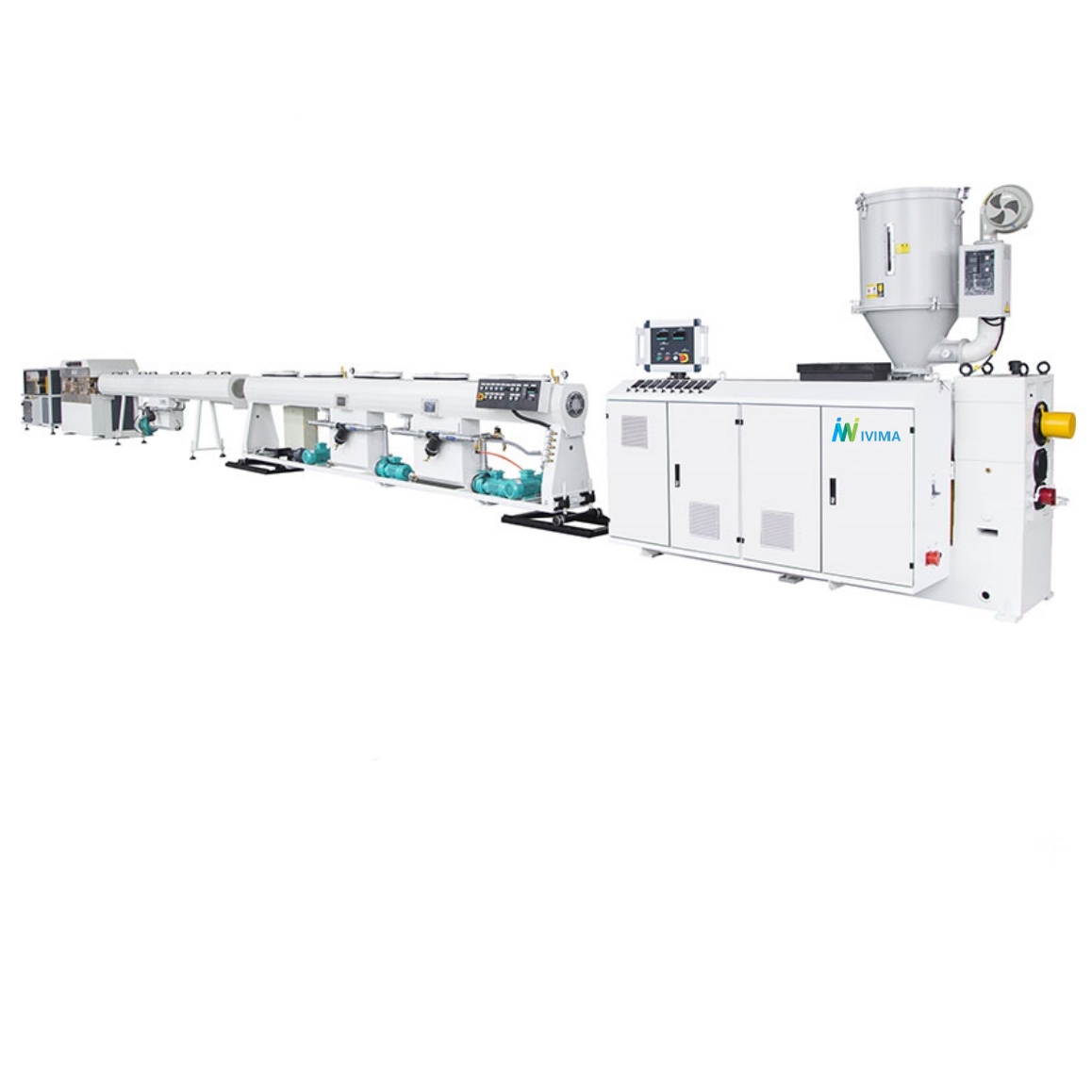
The cooling process requires distinct zones. The first stage utilizes a specialized pipe calibration tank. This tank applies vacuum pressure while showering the pipe exterior. The vacuum holds the soft plastic tightly against a brass or stainless sizing sleeve. This tank usually spans 6 to 9 meters in length. It forms the crucial outer diameter. Precision control here prevents ovality completely.
Secondary cooling follows this initial stage. Atmospheric spray tanks handle the remaining thermal load. They flood the pipe exterior using atomized water droplets. Spray cooling outperforms total water immersion. Droplets evaporate quickly upon hitting the hot pipe. This phase change absorbs massive amounts of heat energy rapidly.
You must stage the temperature gradient carefully. Never shock the hot plastic. Plunging molten HDPE into ice-cold water causes absolute disaster. The outer skin shrinks violently. The inner core remains expanded. This thermal shock traps massive residual stress inside the wall. Instead, use multiple tanks in series. Gradually decrease the water temperature across the production line. Start your first tank at 20°C. Drop the final tank down to 15°C. This staged approach produces superior mechanical properties.
Traditional manufacturing relies heavily on physical length. Adding more standard water tanks removes more heat. This method represents the standard baseline for many factories. However, this approach demands massive factory floor space. Standard large-diameter lines can stretch over 40 meters long. Space constraints often make this traditional setup impossible for growing businesses.
Modern engineering offers intensive, space-saving cooling alternatives. High-volume atomized spray nozzles improve heat transfer significantly. A fine water mist absorbs heat much faster than a solid water stream. Chilled water integration also accelerates the process safely. Some advanced manufacturers employ internal pipe cooling (IPC) technologies. IPC circulates cold air or mist directly through the hollow pipe core. This cools the thick plastic wall from both sides simultaneously. IPC reduces cooling time dramatically.
Buyers must evaluate capital expenditure carefully against operational constraints. You face a clear strategic choice during procurement.
You could purchase a physically longer plastic pipe machine featuring traditional tanks. This minimizes initial equipment costs.
However, this long line consumes premium factory real estate. It increases your long-term facility leasing costs.
Alternatively, you can invest in a shorter, high-efficiency cooling system featuring IPC.
This high-tech option carries a higher initial purchase price. Yet, the factory space requirements drop dramatically.
Smaller, efficient systems also reduce your daily pumping and utility expenses. They use less water volume overall. This careful analysis shapes your overall operational profitability. You must weigh the upfront cost against your available square footage. Never compromise product quality just to fit a machine into a small room.
A long cooling tank means nothing without proper water volume. Buyers must verify water pump capacities strictly before signing any contract. Evaluate the spray nozzle coverage inside every chamber. Insufficient water pressure creates dry spots on the pipe exterior. These dry spots cool slower than wet areas. Uneven cooling causes the pipe to warp and bend permanently.
Filtration systems represent another critical inspection point. Recycled cooling water often carries microscopic debris. Clogged spray nozzles present a massive production risk. A single blocked nozzle leaves a hot stripe along the moving pipe. This defect ruins the dimensional stability instantly. Always evaluate machine designs for easy-access dual water filters. You should clean one filter safely while the line continues running at full speed. Duplex strainers prevent unnecessary downtime.
Finally, future-proof your investment through equipment modularity. Buy extrusion lines utilizing standardized flange connections. Production demands always change over time. You might secure a contract for thicker pipes next year. Standardized connections allow you to attach extra cooling tanks easily. Ensure your haul-off unit possesses enough traction power. Pulling a heavy pipe through an extra water bath requires substantial motor torque.
Configuring the correct cooling length requires careful mathematical consideration. Your final decision matrix relies on three factors. You must combine your target output requirements, available floor space, and specific pipe dimensions. This formula dictates your required cooling technology.
We strongly recommend a holistic evaluation approach. Do not evaluate an extrusion line purely on the extruder's melting capability. Demand transparent thermodynamic calculations from the manufacturer. They must prove their cooling section can handle your maximum output. This proof must account for your specific SDR and maximum diameter.
For your immediate next steps, contact your equipment supplier. Request a customized line layout drawing for your facility. Ask them to provide a detailed thermal calculation sheet. Verify their water pump sizing matches the required cooling load. Taking these precise steps ensures a profitable, high-speed production environment.
A: Only marginally. Shock-cooling HDPE creates severe residual stress and brittle pipes. Extending the cooling length or improving water flow (spray volume) are the only compliant ways to increase speed safely.
A: Heat transfer in plastics is highly insulating. Doubling the wall thickness increases the required cooling time by roughly a factor of four, heavily impacting the required tank length for thick-walled pipes.
A: Yes, provided your factory has the physical floor space downstream and the haul-off unit can handle the increased traction load of dragging pipe through an additional water bath.