Views: 0 Author: Site Editor Publish Time: 2026-07-08 Origin: Site

Plastic recyclers face a constant, daily battle on the production floor. You must maximize final pellet quality to meet strict market demands. However, managing highly variable scrap inputs loaded with moisture, ink, and organic contamination makes this incredibly difficult. Choosing the wrong extruder architecture directly harms your output. It quickly leads to porous pellets, frequent screen blockages, and wasted energy. These mechanical failures severely limit plant efficiency and downgrade your product value.
This article provides an objective, engineering-focused evaluation framework. We will help you select the right equipment based on your specific material profiles and facility constraints. You will learn exactly when to deploy a single-stage system versus a double-stage line. By understanding these core mechanical differences, you can secure optimal results for your recycling operation.
Single-stage lines offer lower CAPEX and energy consumption, ideal for clean, dry, post-industrial scrap with minimal contamination.
Double-stage lines (mother-baby extruders) are mandatory for post-consumer waste, offering superior dual-degassing and double-filtration to handle high moisture and heavy inks.
Material bulk density and format (film vs. rigid) dictate front-end integrations, requiring specific configurations like an agglomerate type pelletizing line or a side force feeding PP PE pelletizer.
Total Cost of Ownership (TCO) must account for the secondary extruder's higher energy draw and maintenance overhead versus the premium price commanded by high-quality, defect-free pellets.
Buyers often misunderstand extrusion requirements. They frequently wonder when a single long screw provides sufficient processing power. Conversely, they question when the physical separation of a two-stage system becomes mechanically necessary. The answer lies in the physics of polymer melting and gas extraction.
A single-stage system operates on a straightforward principle. It uses one primary extruder to complete the entire recycling process. You feed the material into a single barrel housing one continuous screw. This single zone handles melting, degassing, and final extrusion in one linear flow.
This architecture offers several distinct strengths. First, it requires a much smaller facility footprint. Second, it demands significantly lower baseline power consumption. Finally, it reduces your overall maintenance variables. You only need to service one gearbox, one motor, and one heating system. When processing stable materials, this simplicity drives exceptional reliability.
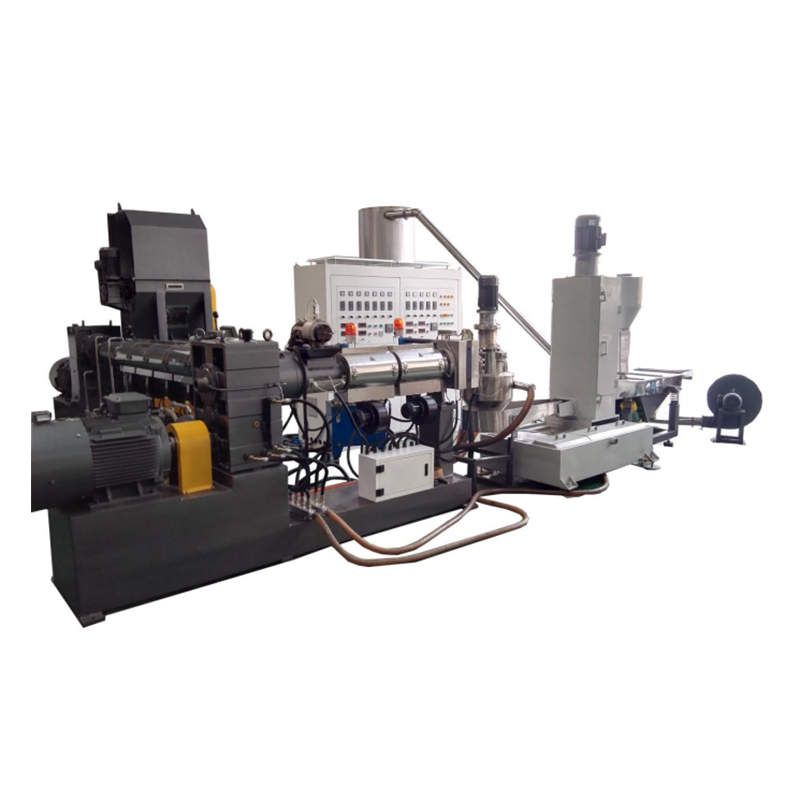
A double-stage architecture introduces a deliberate physical break in the extrusion process. We commonly call this a "mother-baby" configuration. The primary "mother" extruder receives the raw material. It melts the plastic and performs initial degassing. Instead of pushing this melt directly through a die, it feeds the molten polymer into a secondary "baby" extruder.
This secondary unit usually runs at a slower speed. It also operates at different temperature profiles. The physical drop between the first and second stages creates a massive operational advantage. It allows trapped gases, severe moisture, and volatile inks to escape rapidly. Here is how the step-by-step process typically unfolds:
The mother extruder melts the contaminated scrap and applies intense shear.
The material passes through the first filtration screen, removing large physical impurities.
The melt drops into the baby extruder, experiencing a sudden pressure drop.
This pressure drop releases volatile gases into a secondary vacuum degassing zone.
The baby extruder pushes the clean melt through a final, ultra-fine screen changer.
This dual-filtration and dual-degassing capability makes double-stage systems uniquely powerful. They excel at purifying highly degraded plastics.
Your success depends on precise alignment. You must match the machine capabilities to the exact physical realities of your input material. Ignoring this rule guarantees operational bottlenecks. To maximize output, you must evaluate a Plastic Pelletizing Machine based on moisture levels and contamination thresholds.
Single-stage systems thrive on predictable, clean inputs. You should specify this architecture when processing clean industrial scrap or factory edge trims. They also handle off-spec virgin resins beautifully. Thoroughly washed and rigorously dried rigid flakes run perfectly in these machines.
However, strict thresholds apply. Your input material must consistently hold less than 3-5% moisture. It must also lack heavy printing, paper labels, or organic contaminants. If your scrap fits this profile, a single-stage system maximizes your processing efficiency.
Certain materials absolutely demand double-stage processing. Post-consumer agricultural films represent a prime example. Heavily printed packaging and degraded plastics also require this heavy-duty approach. Washed flakes retaining high residual moisture will fail in a single-stage setup.
A double-stage system prevents "foaming." Foaming creates hollow, brittle pellets full of trapped gas. By providing a secondary vacuum degassing zone, the mother-baby system eliminates this defect. Furthermore, it handles higher mesh-count screen changers. This allows you to filter out microscopic impurities without causing fatal backpressure in the primary barrel.
Material Suitability Guidelines
Material Characteristic | Single-Stage Suitability | Double-Stage Suitability |
|---|---|---|
Clean Industrial Trim | Excellent | Overkill |
Moisture Content < 3% | Optimal | Acceptable |
Moisture Content > 5% | Not Recommended (Foaming Risk) | Excellent (Dual Venting) |
Heavy Ink / Printed Film | Poor | Optimal |
High Organic Contamination | Poor (Frequent Screen Blinding) | Excellent (Dual Filtration) |
The best extrusion architecture will still fail if the front-end feeding system struggles. The feeding mechanism must handle the material's specific bulk density. Otherwise, the screw will run empty, causing severe output fluctuations.
Lightweight films and raffia present unique feeding challenges. They lack the weight to gravity-feed reliably. In these cases, you need a specialized solution. An Agglomerate Type Pelletizing Line provides the perfect configuration. It features an integrated cutter-compactor tank. Rotating blades create friction, which pre-heats, dries, and densifies the material. The compactor then centrifugally forces this dense mass directly into the extruder screw. This guarantees stable, high-capacity throughput for difficult films.
Fluffy, low-bulk-density crushed materials often resist gravity feeding entirely. They bridge inside standard hoppers, halting production. To solve this, you must specify a Side Force Feeding PP PE Pelletizer. This configuration places an auxiliary auger screw on the side of the main barrel. The side feeder mechanically rams the fluffy flakes into the main screw. It forcefully prevents bridging and ensures the barrel remains completely full. This maximizes your output capacity for low-density plastics.
Rigid regrind offers excellent bulk density. It feeds easily without aggressive compaction. However, you often need to blend this regrind with specific additives. A Dose-Feeding Plastic Pelletizer manages this perfectly. It uses precision volumetric or gravimetric dosers. This setup allows you to blend precise ratios of masterbatch colors or calcium carbonate. It ensures absolute melt consistency and perfect color uniformity across massive production runs.
Evaluating extrusion lines requires moving beyond initial capabilities. You must understand the day-to-day physical realities on your factory floor. Facility layout and maintenance workflows dictate your long-term success.
Space planning poses a significant challenge. Double-stage lines require substantially more floor space. You must accommodate the secondary machine, its independent drive system, and the connecting transition chute. Facility layouts usually demand a long linear footprint or an L-shaped configuration. Before selecting a double-stage system, you must physically map your factory floor to guarantee adequate clearance for operation and safe maintenance access.
Power draw represents a major operational factor. Double-stage systems inherently consume more electricity. You are powering two distinct motors, two gearboxes, and two sets of barrel heating zones. Generally, double-stage systems consume roughly 20-30% more energy per kilogram processed compared to single-stage units. You must ensure your facility's electrical infrastructure can handle this increased kilowatt demand without tripping breakers.
Maintenance complexity scales with equipment size. Single-stage lines minimize mechanical headaches. Operators only manage one gearbox and one motor. They also handle one primary screen changer.
Double-stage lines demand sophisticated oversight. They require synchronized maintenance schedules. Here are common practices to watch out for:
Operators must carefully balance the screw speeds between the mother and baby extruders to prevent overflowing the transition chute.
Screen changes must be staggered. The mother extruder screen blocks faster due to heavier initial contamination.
Two separate gearboxes require distinct oil change intervals and vibration monitoring.
Temperature profiles must be mapped accurately across both barrels to prevent polymer degradation during the physical drop.
System Comparison Chart
Operational Metric | Single-Stage System | Double-Stage System |
|---|---|---|
Footprint Required | Compact (Linear) | Large (Linear or L-Shape) |
Energy Draw (kW) | Baseline Standard | 20-30% Higher |
Moving Parts | Minimal (1 Motor, 1 Gearbox) | Complex (2 Motors, 2 Gearboxes) |
Screen Changers | Single Point | Dual Points |
Operator Training | Standard | Advanced (Synchronization Required) |
Selecting the correct pelletizing architecture dictates your product quality. It also defines your daily operational efficiency. Choose a single-stage system for high efficiency and clean, dry inputs. Choose a double-stage system for heavy-duty processing of wet, dirty, post-consumer waste.
To finalize your decision, take these immediate actions:
Audit your primary scrap sources specifically for moisture content and ink levels.
Measure your available factory floor space to confirm layout feasibility.
Request a material-specific test run from equipment manufacturers before making a short list.
Assess your operators' current technical capabilities regarding synchronized machine controls.
By applying this engineering framework, you will install a system that delivers consistent, high-grade pellets without unnecessary downtime.
A: It is highly discouraged unless the film is exceptionally well-dried and minimally printed. High moisture will inevitably cause foaming. This requires a double-stage system for proper vacuum degassing.
A: While variable by capacity and brand, double-stage lines typically require a 30-40% higher initial CAPEX. This accounts for the additional motor, gearbox, heated barrel, and synchronized control systems.
A: Generally no. Upgrading requires specific screw designs, altered L/D ratios, and complex control panel integration for synchronized "mother-baby" operation. The architecture decision must be made at the initial procurement stage.
A: A cutter-compactor (agglomerator) uses high-speed friction blades to heat and densify lightweight films before extrusion. Conversely, a side force feeder uses a mechanical auger screw to push cold, fluffy flakes directly into the main extruder barrel.